If you’re dealing with jaw pain, clicking, headaches, or tightness around your face and neck, it can be difficult to figure out what’s actually causing your symptoms.
Is it your TMJ?
Is it your neck?
Or is it both?
At Voltex Physical Therapy, this is one of the most common things we help people understand, because in many cases, jaw pain and neck pain are closely connected
Dealing with jaw pain in Austin? See how our Doctors of Physical Therapy treat it one-on-one on our TMJ physical therapy in Austin page, or book a free 15-minute consult.
Why TMJ and Neck Pain Are So Closely Related
The temporomandibular joint (TMJ) and the cervical spine (neck) are connected through both biomechanics and the nervous system.
They share:
- Muscle and fascial connections
- Coordinated movement patterns
- Neural pathways that influence pain and muscle activation
Research shows that up to 70% of patients with temporomandibular disorders (TMD) also present with neck pain and dysfunction, including stiffness, muscle tenderness, and reduced mobility.
This means your symptoms may not be coming from just one area — even if it feels that way.
TMJ vs Neck Pain: How to Tell the Difference
While the jaw and neck are connected, certain patterns can help identify what may be the primary driver of your symptoms.
Signs Your Pain Is Primarily TMJ-Related
You may be dealing more with a TMJ issue if you notice:
- Pain directly in the jaw joint (in front of the ear)
- Clicking, popping, or locking when opening or closing your mouth
- Pain with chewing, talking, or yawning
- Limited mouth opening or deviation when opening
- Jaw fatigue, tightness, or clenching
These symptoms typically point toward local joint irritation or muscle dysfunction in the jaw.
Signs Your Pain Is Primarily Coming From the Neck
You may be dealing more with a cervical (neck-driven) issue if you notice:
- Pain that starts in the neck and radiates into the jaw, face, or head
- Stiffness when turning your head
- Pain that worsens with posture (desk work, phone use, driving)
- Frequent headaches, especially at the base of the skull or temples
- Improvement when the neck is stretched, mobilized, or treated
These symptoms suggest that the cervical spine may be contributing significantly, even if you feel the pain in your jaw
The Most Common Scenario: It’s Both?
In reality, most patients don’t fall into just one category.
A common pattern we see:
- The neck becomes stiff or restricted
- The jaw compensates to maintain movement
- Muscles in both regions become overactive and sensitive
This creates a cycle:
Neck dysfunction → altered jaw mechanics → increased muscle tension → pain
If you only treat the jaw, symptoms often return because the underlying driver hasn’t been addressed.
Why This Matters for Treatment
This is where many treatment approaches fall short.
- Mouthguards may protect your teeth but don’t improve movement
- Massage alone may temporarily reduce tension
- Treating only the jaw ignores cervical involvement
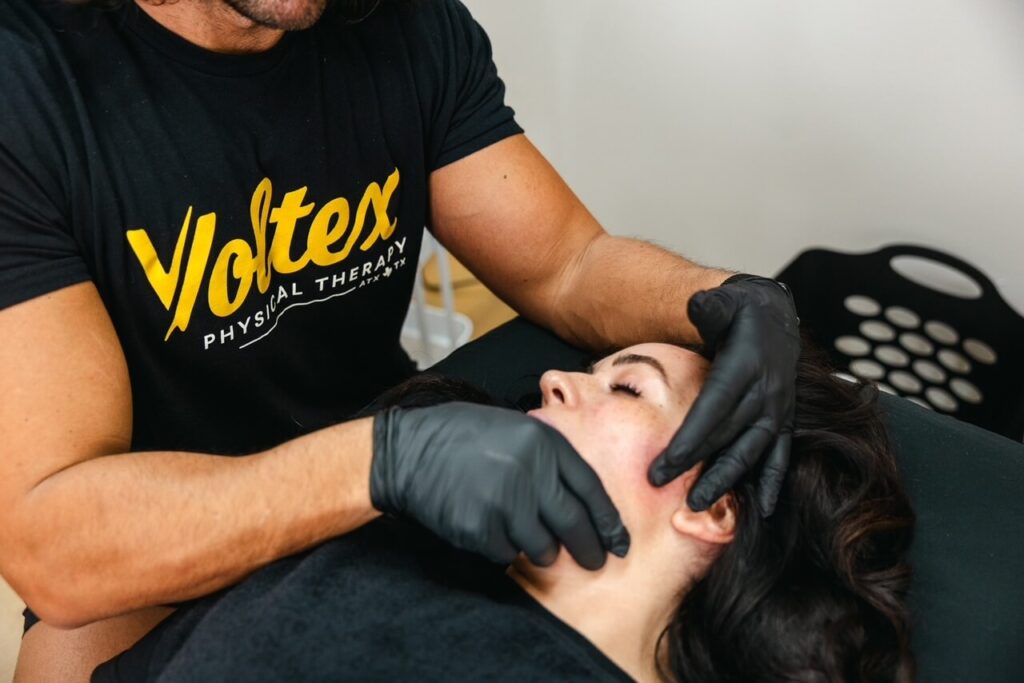
At Voltex Physical Therapy, we take a systems-based approach, evaluating both the TMJ and cervical spine to identify what’s truly driving your symptoms.
How We Treat TMJ and Neck Pain at Voltex
Our approach is built around addressing both regions when needed:
- Manual therapy to restore joint mobility in the TMJ and cervical spine
- Dry needling to reduce muscle tension in the jaw and neck
- Neuromuscular re-education (Neubie) to improve coordination and muscle control
- Movement and posture training to reduce long-term strain
This allows us to address the root cause, not just the symptoms.
When Should You Get Evaluated?
You should consider a physical therapy evaluation if you have:
- Persistent jaw pain or clicking
- Neck pain that radiates into the face or jaw
- Headaches associated with jaw or neck tension
- Limited mouth opening
- Pain with chewing or talking
The earlier you identify the source of your symptoms, the easier it is to treat effectively.
TMJ Treatment in Austin, TX
If you’re unsure whether your symptoms are coming from your jaw, your neck, or both — we can help you figure it out.
At Voltex Physical Therapy, we specialize in TMJ and cervical spine treatment for active adults in Austin.
📱 Text: 512-200-4067
📧 Email: hello@voltexpt.com
Research Supporting Our Approach
- Silveira A, et al. (2015) – Jaw dysfunction is associated with neck disability and muscle tenderness in TMD patients. Journal of Oral Rehabilitation.
- Armijo-Olivo S, et al. (2011) – Relationship between the cervical spine and craniofacial pain. Journal of Orofacial Pain.
- Olivo SA, et al. (2010) – Strong association between neck disability and jaw dysfunction in TMD patients.
- Cuenca-Martínez F, et al. (2020) – Cervical spine impairments commonly present in TMD patients. Systematic Review & Meta-Analysis.
- La Touche R, et al. (2009) – Cervical manual therapy improves pain and function in patients with temporomandibular disorders.
- Reynolds B, et al. (2020) – Cervical and postural interventions improve outcomes in patients with TMD. Journal of Orthopaedic & Sports Physical Therapy.
- Bednarczyk V, et al. (2024) – Cervical rehabilitation improves pain in myogenic TMD. Systematic Review & Meta-Analysis.
- de Wijer A, et al. (1996) – High prevalence of cervical spine symptoms in individuals with temporomandibular disorders. Journal of Oral Rehabilitation.