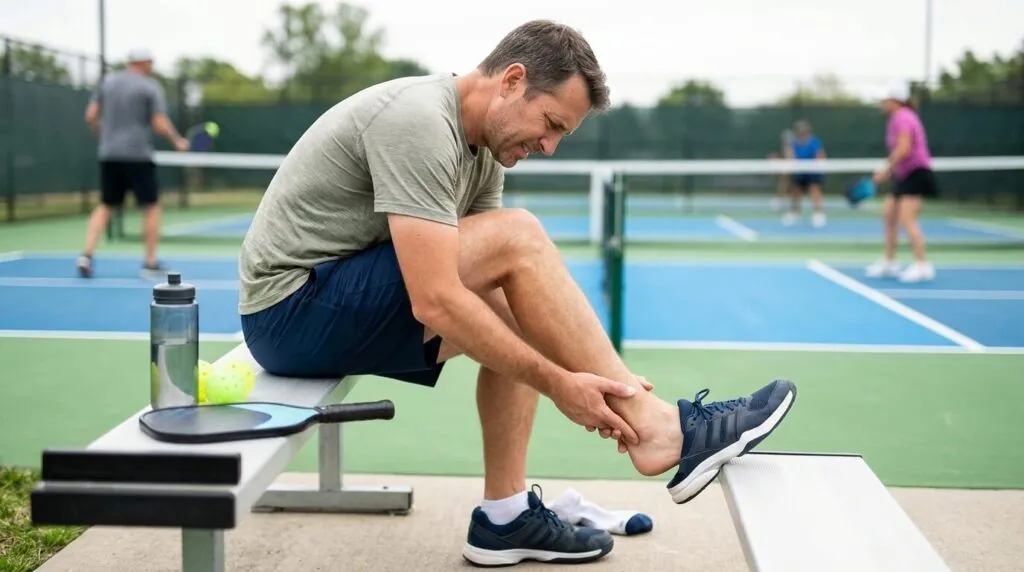
A physical therapist’s guide to why the Achilles takes a beating on the pickleball court, how to tell what you’re dealing with, and the plan that gets you back to playing
You finish a few games of pickleball feeling great, until you notice an ache behind your heel. The next morning your first steps out of bed are stiff. After moving around it loosens up, so you play again. Then the cycle repeats.
Maybe you’ve started skipping games, stretching more, or wondering if your heel will ever feel normal again. I see this every week at Voltex Physical Therapy in Austin, and the good news is that Achilles pain responds well to the right plan. That plan is rarely just rest, and it’s almost never more stretching. Here’s what’s probably going on, what to do this week, and how we get pickleball players back on the court.
Why Pickleball Irritates the Achilles
Your Achilles tendon connects your calf muscles to your heel bone and handles every push-off, acceleration, stop and change of direction you make. Pickleball asks for all of that, over and over: quick steps up to the kitchen line, lunging for a dink, backpedaling for a lob, then sprinting forward again. Each of those loads the tendon with several times your body weight.
The tendon copes fine with that as long as the load is one it’s used to. Pain tends to show up when the load changes faster than the tendon can adapt:
- Playing more than usual. Three games a week becoming open play five days a week, or a tournament weekend on top of a normal schedule.
- Coming back after time off. A vacation, an illness or a summer away from the heat, then straight back into full sessions.
- Picking the sport up later in life. Most of the players we see are in their 40s, 50s and 60s. Tendons stiffen and recover more slowly with age, and a sport built on quick stops and starts is a big change for an Achilles that has spent years walking.
- Hard courts and worn shoes. Austin’s outdoor courts are concrete, and running shoes don’t give the lateral support court movement needs.
Foot and ankle injuries, including Achilles problems, are increasingly common in pickleball players as the sport has grown. [1] It isn’t that pickleball is dangerous; it’s that the tendon needs to be prepared for it.
Where Does It Hurt? Midportion vs. Insertional
This is the first thing I check, because the location changes the plan.
Midportion Achilles tendinopathy
Pain and tenderness an inch or two above the heel bone, in the “rope” part of the tendon, sometimes with a thickened spot you can feel. This is the more common version and responds very well to progressive loading. [2, 3]
Insertional Achilles tendinopathy
Pain right at the back of the heel bone where the tendon attaches, often worse with uphill walking, stairs and anything that pulls the foot up toward the shin. This version doesn’t like being stretched or compressed against the bone. Heel drops off the edge of a step and aggressive calf stretches, the two things most people try first, tend to make it worse. A 2025 randomized trial found that rehab designed to avoid tendon compression (no dorsiflexion stretching, heel raises done on flat ground) outperformed standard care for insertional cases. [4]
Clinical note: If your pain is at the heel bone itself, stop the stretching and the step heel-drops today. Flat-ground heel raises and a small heel lift in your shoe are the better starting point.
Is It Tendinopathy or Something Else?
Achilles tendinopathy usually builds gradually: morning stiffness, tenderness, pain with push-off that eases once you’re warm and returns later or the next day. [2, 3] A few other things can feel similar, which is why an assessment matters:
- Calf strain (“tennis leg”). A sudden pull higher up in the calf during a push-off, with bruising or swelling in the days after. Different structure, different timeline.
- Retrocalcaneal bursitis. Swelling and pain at the heel bone that’s worse with shoe pressure; often travels with insertional tendinopathy.
- Nerve or ankle joint pain that refers to the heel.
If you felt a sudden pop, have significant swelling, or suddenly can’t push off or rise onto your toes, stop playing and get assessed promptly. That can be an Achilles tear, and the first few days matter. [5]
What to Do This Week
Start by adjusting how much you play, not by stopping completely. Tendons that are rested lose capacity; tendons that are loaded appropriately rebuild it. The current clinical practice guideline supports staying active within tolerable limits rather than total rest. [2]
The rule we give every player is the pain-monitoring model, which comes from the same research group that built most of the modern Achilles rehab evidence: [6]
- Pain up to 5 out of 10 during and right after play is acceptable. Above that, you did too much.
- It should settle back to your baseline by the next morning. If the morning stiffness is clearly worse than it was, cut the next session.
- Trend over a week, not a day. Pain that’s slowly improving week over week means the plan is working, even if individual days vary.
In practice that usually means fewer games per session, a day between sessions, skipping the tournament for now, and a proper warm-up (five minutes of brisk walking, then 20 to 30 easy heel raises) before the first point. A heel lift in both shoes for a few weeks reduces tendon load and often takes the edge off quickly.
Why Strengthening Your Calves Beats Stretching
It’s tempting to stretch a sore Achilles, but stretching doesn’t change the thing that’s actually wrong: a tendon that can’t currently handle the load you’re asking of it. Progressive loading is the first-line treatment for midportion Achilles tendinopathy, with the strongest evidence of any option. [2, 3] Both the classic eccentric heel-drop protocol and heavy, slow heel raises work; a randomized trial found similar outcomes at a year, with people preferring the heavy-slow version because it takes less time. [7, 8]
Here’s the progression we use. Move to the next stage when the current one is easy and the morning-after test passes.
1. Isometric holds (days, not weeks)
Rise up onto both toes, shift most of your weight to the sore side, and hold for 30 to 45 seconds. Five holds. This calms the tendon down and is a good pre-game warm-up for the rest of your rehab.
2. Double-leg heel raises
Three seconds up, three seconds down, 3 sets of 15, every other day. Flat ground if your pain is at the heel bone; off the edge of a step only if it’s midportion and tolerates it.
3. Single-leg heel raises
Same tempo. When you can do 3 sets of 15 on one leg, add weight: a backpack, a kettlebell in one hand, or the calf raise machine. Heavy and slow is the goal. [7]
4. Bent-knee heel raises
The soleus, the deeper calf muscle, does a huge share of the work in pickleball’s short, quick steps, and it’s only trained with the knee bent. Seated calf raises or bent-knee standing raises, same sets and tempo.
5. Hops, skips and court drills
Once single-leg heavy raises are pain-free, the tendon needs to learn to handle speed again: two-leg hops, then single-leg hops, then skipping, then shuffle-and-sprint drills that look like a point. This is the stage most people skip, and it’s why the pain comes back the first week they go back to full play.
The tendon doesn’t need to be stretched longer. It needs to be made stronger.
Getting Back to Full Play
Build court time the way you built the strength: short, easy sessions first, then more games, then back-to-back days, then tournaments. Court shoes rather than running shoes make a real difference for the lateral movement. And keep the heavy calf work going twice a week after the pain is gone; tendons that were loaded consistently stay healthy, and the ones that stopped the day they felt better tend to come back to see me.
How We Treat Achilles Pain at Voltex
Your first visit is a 75-minute, one-on-one evaluation with a Doctor of Physical Therapy. We learn your goals and playing schedule, test calf strength and endurance on each side, check ankle and hip mobility, watch how you move on the court-style drills that matter, and build a plan around you.
- A plan you can use outside the clinic. You leave the first visit knowing how much pickleball you can handle right now and exactly what to work on between sessions.
- Blood flow restriction training. Especially useful for tendons: it lets us build calf strength with light loads the irritated tendon tolerates, so the strengthening starts in week one instead of week four.
- Hands-on care when it helps. Manual therapy for the ankle and calf, dry needling for the tight calf muscles that often come with it, and NEUBIE to re-educate the calf during loading.
- Visits that go beyond a handout. Follow-ups are 60 minutes, one-on-one, spent on progress checks, coaching and building toward real pickleball movement.
See how we work with pickleball and tennis players at Voltex. And if the elbow is bothering you too, that’s the other injury we see most on the court: pickleball elbow vs. tennis elbow.
Frequently Asked Questions
Can I keep playing pickleball with Achilles pain?
Often, yes, within the pain-monitoring rules above: pain no higher than 5 out of 10 during play, settling by the next morning. The exceptions are a sudden pop, major swelling or loss of push-off strength, which need urgent assessment.
Should I stretch my Achilles?
Not as the main treatment. Progressive strengthening matters far more, and deep stretching and heel drops off a step can aggravate insertional tendon problems. [4] Gentle calf stretching is fine for midportion cases if it feels good; it just isn’t what fixes it.
How long does it take to get better?
Tendons change slowly. Most players feel meaningfully better in six to eight weeks of consistent loading, and a full return to tournament-level play typically takes about twelve weeks. Starting the right loading early is what shortens that, which is why “rest it and see” tends to cost people a season.
Do I need an MRI or an injection?
Rarely. Achilles tendinopathy is diagnosed by history and examination, and imaging seldom changes the plan. Corticosteroid injections into or around the Achilles are generally avoided because of the risk of tendon rupture. Loading is the treatment with the evidence behind it. [2, 3]
The Bottom Line
You don’t have to wait until Achilles pain keeps you off the court to ask for help. If you’re tired of guessing your way through it, start with a free 15-minute phone consultation, or book directly with me. Voltex is a one-on-one clinic in North Austin; we accept HSA and FSA and provide superbills for possible out-of-network reimbursement.
👉 Book a free 15-minute consult, or skip the call and book your first visit online. Questions? (512) 200-4067 · 5555 N Lamar Blvd, Ste C105, Austin, TX 78751.
References
- Kingston K, Parker EB, Higgins A, Smith JT. Emerging Patterns of Foot and Ankle Injuries in Pickleball Players: A Short Report. Foot & Ankle International. 2024. https://pubmed.ncbi.nlm.nih.gov/39188128/
- Chimenti RL, Martin RL, Cuddeford T, et al. Achilles Pain, Stiffness, and Muscle Power Deficits: Midportion Achilles Tendinopathy Revision – 2024. Clinical Practice Guidelines Linked to the International Classification of Functioning, Disability and Health from the Academy of Orthopaedic Physical Therapy of the American Physical Therapy Association. Journal of Orthopaedic & Sports Physical Therapy. 2024. https://www.jospt.org/doi/10.2519/jospt.2024.0302
- Silbernagel KG, Hanlon S, Sprague A. Current Clinical Concepts: Conservative Management of Achilles Tendinopathy. Journal of Athletic Training. 2020;55(5):438–447. https://pmc.ncbi.nlm.nih.gov/articles/PMC7249277/
- Pringels L, et al. Effectiveness of reducing tendon compression in the rehabilitation of insertional Achilles tendinopathy: a randomised clinical trial. British Journal of Sports Medicine. 2025. https://pubmed.ncbi.nlm.nih.gov/40011018/
- American Academy of Orthopaedic Surgeons. Achilles Tendon Rupture (Tear). OrthoInfo. https://www.orthoinfo.org/bodypart/foot-ankle/achilles-tendon-rupture-tear/
- Silbernagel KG, Thomeé R, Eriksson BI, Karlsson J. Continued sports activity, using a pain-monitoring model, during rehabilitation in patients with Achilles tendinopathy: a randomized controlled study. American Journal of Sports Medicine. 2007;35(6):897–906. Google Scholar
- Beyer R, Kongsgaard M, Hougs Kjær B, Øhlenschlæger T, Kjær M, Magnusson SP. Heavy Slow Resistance Versus Eccentric Training as Treatment for Achilles Tendinopathy: A Randomized Controlled Trial. American Journal of Sports Medicine. 2015;43(7):1704–1711. https://pubmed.ncbi.nlm.nih.gov/26018970/
- Alfredson H, Pietilä T, Jonsson P, Lorentzon R. Heavy-load eccentric calf muscle training for the treatment of chronic Achilles tendinosis. American Journal of Sports Medicine. 1998;26(3):360–366. Google Scholar