Pickleball Elbow vs. Tennis Elbow: What’s the Difference — and How Do You Fix It?
If you’ve been logging hours on the pickleball courts at Austin’s Metz Recreation Center or playing league tennis at Pharr Tennis Center and you’ve started noticing a burning ache on the outside of your elbow, you’re not alone. Lateral elbow pain is one of the most common complaints we see at Voltex Physical Therapy — and it’s on the rise, especially among Austin’s fast-growing pickleball community.
But here’s something most people don’t realize: pickleball elbow and tennis elbow are not exactly the same thing. They share a diagnosis name — lateral epicondylitis — but the way they happen, who gets them, and what makes them worse differs in important ways. Treating them the same is one of the main reasons people end up with pain that drags on for months.
This guide breaks down the differences, what’s actually going on in your tissue, and how Voltex PT treats both — so you can get back on the court faster.
What Is Lateral Epicondylitis (and Why Do Both Sports Cause It)?
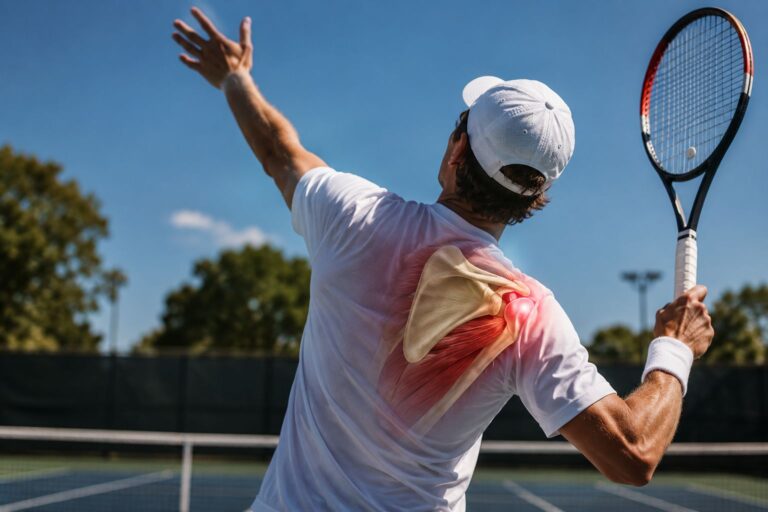
Lateral epicondylitis refers to pain and tendon damage at the lateral epicondyle — a small bony bump on the outside of the elbow where the forearm extensor muscles attach. When you repeatedly extend your wrist or grip a paddle or racket, these tendons absorb significant load. Over time, that repetitive stress creates micro-tears in the tendon, leading to degeneration, pain, and weakness.
Both pickleball and tennis involve repetitive forearm extension, wrist snap, and grip — which is why both sports produce this injury. But the specifics matter.
Key Differences Between Pickleball Elbow and Tennis Elbow
1. Paddle vs. Racket: Impact Transmission
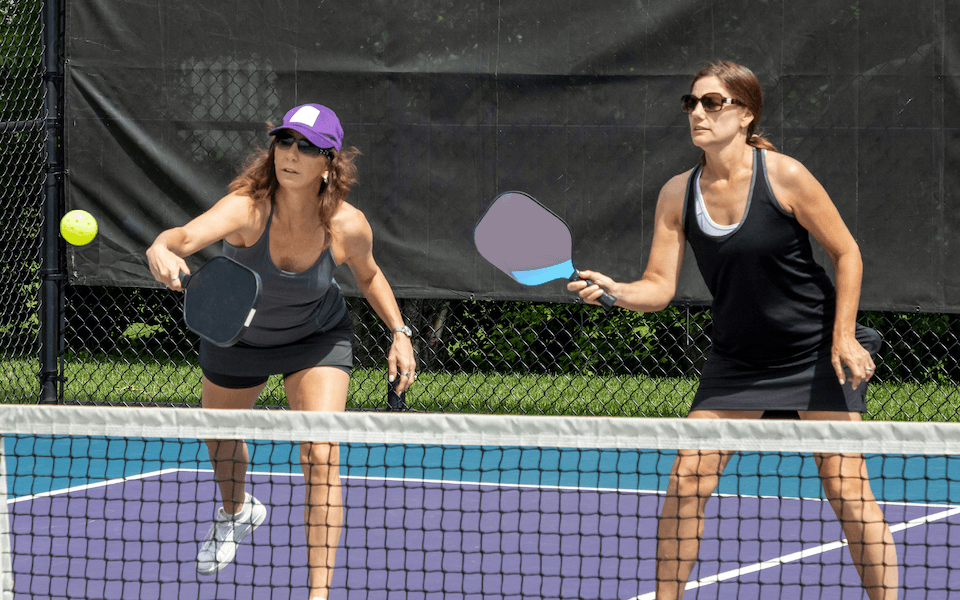
A tennis racket has string tension that absorbs and disperses impact when the ball makes contact. A pickleball paddle is solid — there’s no give. When the hard polymer pickleball hits a solid paddle, that shock travels directly up your forearm. Over the course of a two-hour session with hundreds of dinks, volleys, and drives, that’s a lot of cumulative load on your lateral elbow tendons.
2. Shot Patterns and Wrist Mechanics
Tennis strokes are longer and more powerful, with a full kinetic chain from the ground up — legs, hips, torso, shoulder, and finally the arm. In pickleball, the kitchen (non-volley zone) forces a compact game. Dinks, resets, and net battles involve rapid, short wrist movements and very little body rotation. Players rely much more heavily on their forearm and wrist in isolation. This smaller range of motion with high repetition is a recipe for tendon overuse.
3. Who Gets It
Classic tennis elbow has traditionally been seen in competitive players with poor technique or equipment mismatch. Pickleball elbow is increasingly common in players over 50 who are new to racket sports, playing frequently without proper conditioning, and underestimating the physical demand of a game that looks “low impact” from the outside. In Austin, we see a lot of pickleball converts who played tennis or golf for years but have recently shifted to pickleball — and their elbows are paying for the transition.
4. Rate of Loading
Pickleball’s faster pace means shorter recovery time between shots, especially in fast hands battles at the net. That rapid-fire loading doesn’t give tendons time to recover between hits — compounding micro-stress far more quickly than a slower-paced recreational tennis match would.
Symptoms: How Do You Know Which One You Have?
Honestly, the symptoms of pickleball elbow and tennis elbow are nearly identical because they involve the same tissue. What differs is often the history and onset pattern:
Pain on the outer (lateral) side of the elbow
Aching that starts during play and lingers afterward
Weak grip — you may notice it when opening jars, turning a doorknob, or holding a coffee cup
Pain with wrist extension or forearm rotation
Tenderness directly on the lateral epicondyle when pressed
In chronic cases: morning stiffness, night pain, or pain with everyday tasks like typing
Important: Pain on the inside of the elbow is a different condition called medial epicondylitis (golfer’s elbow) and requires a different treatment approach. If you’re unsure which side hurts, we’re happy to evaluate you — that’s exactly what a free discovery call at Voltex PT is for.
Why Does Pickleball Elbow Become Chronic for So Many People?
This is the part most players (and a lot of treatment approaches) miss. In the early stages, lateral epicondylitis involves real inflammation. But if you keep playing through it — even at reduced intensity — the tendon doesn’t get the rest it needs to heal. What was an inflammatory injury becomes a degenerative one.
Chronic tendon degeneration (tendinopathy) involves disorganized collagen, reduced blood flow to the tissue, and a tendon that has lost its normal structure. At this stage, passive rest alone won’t fix it. The tendon actually needs the right kind of loading — progressive, controlled exercise — to stimulate new collagen production and restore tissue quality.
This is why people who “rest it for weeks” often return to pickleball and feel fine for a session or two, then right back to square one. Rest reduces symptoms temporarily. Rehabilitation rebuilds the tendon.
How Voltex PT Treats Pickleball Elbow and Tennis Elbow in Austin
At Voltex Physical Therapy, we take a performance-focused, one-on-one approach to lateral elbow injuries. Rather than handing you a generic exercise sheet and sending you on your way, we assess the full picture — your shoulder mobility, wrist mechanics, grip patterns, and sport-specific movement — to understand why your elbow is overloaded in the first place.
Treatment typically includes:
Progressive Tendon Loading (Eccentric & Isometric Exercise)
This is the cornerstone of tendinopathy rehabilitation. Isometric holds and eccentric exercises — done with the right intensity and timing — stimulate collagen synthesis and restore the tendon’s load-bearing capacity. We guide you through exactly how much load is appropriate for your stage of healing.
Dry Needling
For chronic lateral epicondylitis, dry needling is one of our most effective tools. We use it to target the degenerative tissue directly — stimulating a local healing response, reducing muscle tension in the forearm extensors, and accelerating the tissue remodeling process. Many patients notice significant pain reduction after just 1-2 sessions. You can read more about how we use dry needling at Voltex PT here.
Manual Therapy
Joint stiffness in the elbow, wrist, or even the cervical spine can contribute to lateral elbow loading. We use hands-on manual therapy to restore normal joint mechanics — often resulting in immediate symptom relief and improved movement quality.
NEUBIE Neuromuscular Training
Voltex PT is one of the few clinics in Austin using the NEUBIE device — a cutting-edge neuromuscular electrical stimulation tool that helps retrain the muscles around the elbow to activate properly, reduce protective tension, and recover more efficiently. It’s particularly useful when standard strengthening exercises are too painful to perform initially.
What’s a Realistic Return-to-Court Timeline?
Mild (recent onset, <4 weeks): 2–4 weeks with relative rest, progressive loading, and technique correction.
Moderate (6–12 weeks of symptoms): 4–8 weeks of structured PT, with a gradual return to play protocol.
Chronic/degenerative (>3 months): 8–16 weeks. This requires patience and a systematic plan, but full return to competitive pickleball or tennis is absolutely achievable.
The most important factor in your timeline is catching it early. If you’ve had elbow pain for more than 2 weeks that isn’t improving with rest, that’s your cue to get it evaluated.
5 Ways to Prevent Pickleball Elbow Before It Starts
Check your grip size. A paddle grip that’s too small forces your forearm extensors to work harder to stabilize. Most pickleball paddles should have a 4–4.5″ grip circumference. If you’re unsure, ask at your local Austin pro shop or ask us.
Warm up your forearm extensors. Before play, spend 3-5 minutes on wrist extension stretches and light band exercises. Cold tendons under sudden load are far more vulnerable.
Use your whole body on drives. Even in pickleball, power should come from hip rotation — not just your arm. Getting coaching on your groundstroke mechanics pays injury dividends.
Limit rapid volume increases. If you’ve gone from playing once a week to every day, your tendons haven’t had time to adapt. Increase play frequency gradually — no more than 10% per week.
Strength train your forearms off-court. Wrist curls, reverse wrist curls, and farmer carries build the tendon resilience that protects you during play. These take 10 minutes and should be in every pickleball player’s routine.
Frequently Asked Questions
Can I keep playing pickleball with tennis elbow?
Sometimes — but only with the right modifications. Playing through significant pain usually makes things worse and extends your recovery. A PT can help you identify what level of activity is appropriate for your stage of injury and how to modify your game to stay active while healing.
Should I wear an elbow brace?
A counterforce brace (the strap worn below the elbow) can reduce pain during activity by offloading the lateral epicondyle. It’s a useful temporary tool but not a substitute for rehabilitation. Wearing a brace indefinitely without addressing the underlying tendon issue just delays the problem.
Do I need a cortisone shot?
Cortisone can reduce acute pain quickly, but research consistently shows it does not improve long-term outcomes for lateral epicondylitis — and may actually weaken tendon tissue with repeated use. We recommend trying conservative PT first. If you’ve already had injections, that’s fine — PT still works and is often the follow-up your provider should have recommended alongside it.
Is pickleball elbow the same as tennis elbow?
They share the same tissue diagnosis (lateral epicondylitis) but differ in mechanism, loading pattern, and who gets them. The treatment principles are similar, but a good PT will tailor the rehab to your specific sport and movement patterns.
Ready to Get Your Elbow Feeling Right Again?
At Voltex Physical Therapy, we work one-on-one with Austin’s pickleball and tennis players to get them back on the court faster — without surgery, cortisone shots, or months of guesswork.
Our team specializes in sport-specific rehab, dry needling, manual therapy, and NEUBIE neuromuscular training. We’re located at 5555 N Lamar Blvd, Ste C105, in the Hyde Park neighborhood, and we see players from Mueller, North Loop, Rosedale, and all across Austin.
👉 Book a free 15-minute discovery call today — and let’s make a plan to get you back on the court.
References
Kim TH, et al. The Beneficial Effects of Eccentric Exercise in the Management of Lateral Elbow Tendinopathy: A Systematic Review and Meta-Analysis. J Clin Med. 2021;10(17):3968. https://pubmed.ncbi.nlm.nih.gov/34501416/
Cullinane FL, Boocock MG, Trevelyan FC. Is eccentric exercise an effective treatment for lateral epicondylitis? A systematic review. Clin Rehabil. 2014;28(1):3–19. https://pubmed.ncbi.nlm.nih.gov/23881334/
Ma X, et al. Therapeutic Effects of Dry Needling on Lateral Epicondylitis: An Updated Systematic Review and Meta-analysis. Arch Phys Med Rehabil. https://pubmed.ncbi.nlm.nih.gov/38484834/
Herd CR, Meserve BB. A systematic review of the effectiveness of manipulative therapy in treating lateral epicondylalgia. J Man Manip Ther. 2008;16(4):225–237. https://pubmed.ncbi.nlm.nih.gov/19771195/
Bisset L, et al. Corticosteroid injections, physiotherapy, or a wait-and-see policy for lateral epicondylitis: a randomised controlled trial. 2002;359(9307):657–662. https://pubmed.ncbi.nlm.nih.gov/11879861/
Smidt N, et al. Treating lateral epicondylitis with corticosteroid injections or non-electrotherapeutical physiotherapy: a systematic review. Br J Gen Pract. https://pubmed.ncbi.nlm.nih.gov/24171937/