You sat through a long appointment, a root canal, a crown, or your wisdom teeth coming out. The tooth is fine. But your jaw is not. It aches when you chew, feels tight when you yawn, maybe clicks, or simply will not open as wide as it used to.
You are not imagining it, and nobody did anything wrong. Holding your mouth wide open for a long time is hard on the jaw joint and the muscles around it. In the last few weeks alone, we have treated a couple of clients at our North Lamar clinic whose jaw pain started right after a long dental procedure, and both needed dry needling to get the jaw muscles to let go.
Jaw still sore after dental work? Our Doctors of Physical Therapy treat it one-on-one. See how on our TMJ physical therapy in Austin page, or book a free 15-minute consult.
Why a Long Dental Appointment Can Leave Your Jaw Sore
Your temporomandibular joint (TMJ) handles chewing, talking and yawning all day. What it does not love is staying near its maximum opening, without breaks, for an hour or more. Three things tend to happen.
1. The joint and its tissues get overstretched
Wide, sustained opening stretches the joint capsule and the sensitive tissue behind the disc. In a study of 80 people who had root canal sessions lasting more than two hours, researchers found a significant increase in TMJ pain one week later. Treatment on back teeth caused more pain than front teeth, and women reported more pain than men. The authors recommended splitting long appointments into shorter sessions with breaks to close the mouth [1].
2. The jaw muscles go into guarding
Your masseter and pterygoid muscles work hard to hold the jaw open, then often tighten up afterward to protect the joint. That guarding is helpful for a day or two. When it does not switch off, it leaves you with trigger points, a tight jaw and limited opening. Lab research supports this: in an animal model, holding the jaw near full opening for just 20 minutes made the jaw muscles more pain-sensitive for about a week and kept inflammatory markers raised for up to two weeks [2].
3. A sensitive system tips over
Some people are more vulnerable than others. Previous jaw clicking, clenching or grinding, high stress, poor sleep, or other chronic pain can make a jaw that was coping fine more likely to become painful after a procedure [4]. That is why two people can have the same appointment and only one leaves with a sore jaw.
Which Dental Procedures Are Most Likely to Cause Jaw Pain?
The common thread is time with the mouth open wide, often with force applied to the jaw.
- Wisdom tooth removal. In a study that followed more than 34,000 people for at least five years, having third molars removed raised the risk of a later TMD diagnosis by about 60%, and roughly 23% of TMD cases in that age group could be linked to the extraction [3].
- Root canals, especially on back teeth and in long sessions [1].
- Crowns, bridges and implants that need long appointments or multiple visits close together.
- Long cleanings or orthodontic appointments in people who already clench or have a sensitive jaw.
None of this means you should avoid dental care. It means your jaw may need a little help recovering afterward.
Signs Your Jaw Needs More Than Rest
A few days of soreness is normal. Get your jaw evaluated if any of these last longer than one to two weeks:
- Pain in front of the ear or along the jaw when you chew or talk
- You cannot open as wide as before, or the jaw drifts to one side
- New clicking, popping or catching
- Tightness in the cheeks or temples, or new headaches
- Ear fullness or pain when your ears check out normal
- Neck tension that started around the same time
How We Treat Jaw Pain After Dental Work at Voltex PT
Every session is one-on-one with a Doctor of Physical Therapy for the full hour. After a 75-minute evaluation of your jaw, neck and posture, treatment usually combines the following.
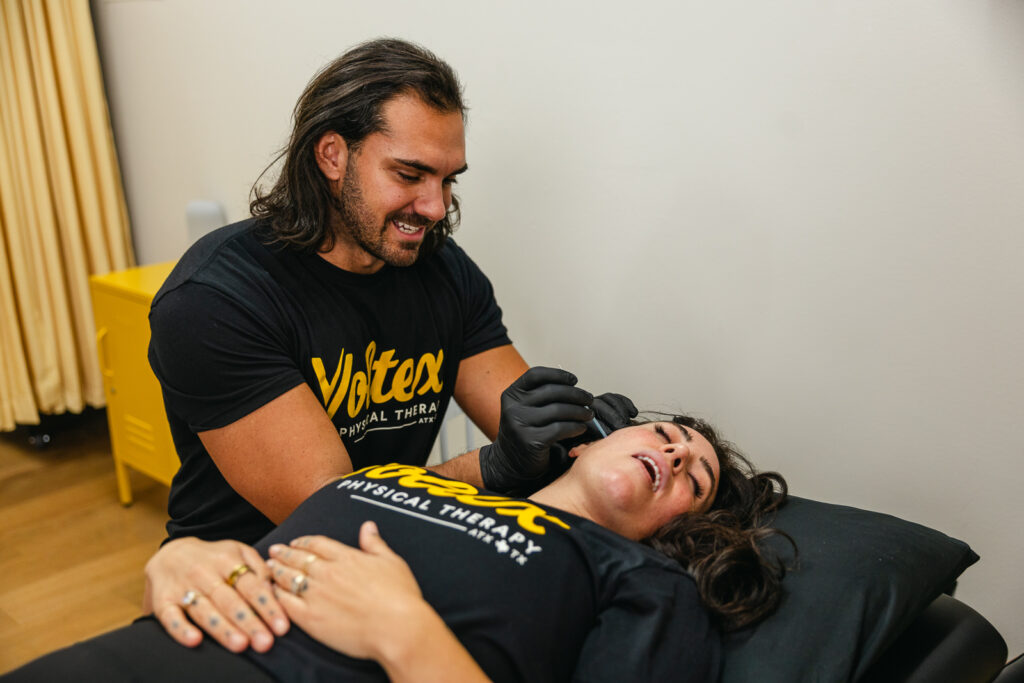
Dry needling for the guarded jaw muscles
When the masseter, temporalis or pterygoid muscles will not let go, dry needling is often the fastest way to calm them down. Research supports it: a small randomized trial found that dry needling active trigger points in the masseter raised pain thresholds and improved mouth opening compared with a sham treatment in people with TMD [5], and a 2025 systematic review of 10 clinical trials found consistent improvements in pain and function [7]. This is exactly what helped the clients we saw recently.
Hands-on manual therapy
Manual therapy restores how the joint glides and opens. That can include gentle joint mobilization, soft tissue work to the jaw muscles, intraoral release of the pterygoids (muscles you can only reach from inside the mouth), and treatment of the upper neck. A systematic review of 20 randomized trials found manual therapy reduces TMD pain and improves mouth opening and function [6].
Exercises and habits that keep it better
- Controlled opening and jaw coordination exercises to restore a straight, full opening
- Neck and posture work, since the jaw and upper neck share nerves and muscles
- Practical tips: resting tongue position, avoiding chewy foods for a short period, and breaking clenching habits
- Planning for your next dental visit, including asking for breaks during long procedures
The Voltex difference: 75-minute evaluations, 60-minute follow-ups, and a Doctor of PT with you the entire session. No aides, no double-booking, and a plan built around getting you back to eating and training normally.
Tips for Your Next Dental Appointment
- Ask for short breaks to close your mouth during long procedures
- Ask whether a bite block or jaw support can be used
- If you already have jaw symptoms, tell your dentist before treatment starts
- Gentle jaw movement and warm compresses in the first few days can help, as long as your dentist agrees
We are happy to coordinate with your dentist or oral surgeon so your jaw and your dental care stay on the same page.
Frequently Asked Questions
Is it normal for my jaw to hurt after dental work?
Some soreness for a few days is common, especially after long appointments or wisdom tooth removal. If your jaw is still sore, tight, clicking, or not opening fully after one to two weeks, it is worth getting it evaluated.
How long does jaw pain last after a dental procedure?
Most mild soreness settles within a few days to a week. Pain that lingers past two weeks is often muscular guarding or joint irritation that responds well to physical therapy.
Can dry needling help jaw pain after dental work?
Yes. When the masseter and pterygoid muscles stay guarded after a procedure, dry needling can reduce trigger point pain and help restore opening. We pair it with manual therapy and jaw exercises.
When should I call my dentist or oral surgeon instead?
Call them first if you have swelling that is getting worse, fever, pus or a bad taste, numbness that is not improving, or severe throbbing pain at an extraction site. Those need to be checked by your dental team.
Do I need a referral to see a physical therapist for jaw pain in Texas?
No. Texas allows direct access to physical therapy for up to 30 days, so you can book an evaluation without a prescription.
Get Your Jaw Back to Normal
If your jaw has not felt right since a dental procedure, you do not have to wait it out. Our North Austin clinic at 5555 N Lamar Blvd, Ste C105 is minutes from Hyde Park, Crestview, Allandale and the North Loop, with free on-site parking. Learn more about our TMJ physical therapy in Austin or book a free 15-minute consult.
References
- Sahebi S, Moazami F, Afsa M, Nabavi Zade MR. Effect of lengthy root canal therapy sessions on temporomandibular joint and masticatory muscles. Journal of Dental Research, Dental Clinics, Dental Prospects. 2010;4(3):95–97. PMC3429977
- Hawkins JL, Durham PL. Prolonged jaw opening promotes nociception and enhanced cytokine expression. Journal of Oral & Facial Pain and Headache. 2016;30(1):34–41. PubMed 26817031
- Huang GJ, Rue TC. Third-molar extraction as a risk factor for temporomandibular disorder. Journal of the American Dental Association. 2006;137(11). PubMed 17082281
- Greene CS, Manfredini D. Transitioning to chronic temporomandibular disorder pain: a combination of patient vulnerabilities and iatrogenesis. Journal of Oral Rehabilitation. 2021;48(9):1077–1088. PubMed 33966303
- Fernández-Carnero J, La Touche R, Ortega-Santiago R, et al. Short-term effects of dry needling of active myofascial trigger points in the masseter muscle in patients with temporomandibular disorders. Journal of Orofacial Pain. 2010;24(1):106–112. PubMed 20213036
- Vieira LS, Pestana PRM, Miranda JP, et al. The efficacy of manual therapy approaches on pain, maximum mouth opening and disability in temporomandibular disorders: a systematic review of randomised controlled trials. Life. 2023;13(2):292. PubMed 36836649
- Khayamzadeh M, Razmara F, Tavassoli A. Dry needling in treatment of temporomandibular joint disorders: a systematic review. Clinical and Experimental Dental Research. 2025;11(5):e70214. PubMed 40917038