A physical therapist’s guide to why the jaw, head and neck act as one system, what posture does and doesn’t do, and how we treat jaw pain by looking past the jaw
If your jaw aches by the end of the workday, clicks when you eat, or feels tight when you wake up, your neck and posture may be part of the story. The jaw, head and neck work as one connected system, which is why I rarely treat a jaw without treating the neck above it.
Jaw problems are among the most common sources of facial pain that aren’t caused by teeth, and most of the people I see with them in our Austin clinic have already been to a dentist, tried a night guard, and been told the joint looks fine. The good news is that most cases respond well to conservative care, and physical therapy is one of the best-supported options. [1, 2] Here’s how the neck fits in, and what we do about it.
What TMD Actually Is
Your temporomandibular joints (TMJs) sit just in front of each ear, where the lower jaw meets the skull. They are among the most-used joints in the body, working every time you talk, chew, swallow or yawn.
Temporomandibular disorders (TMD) is the umbrella term for pain or dysfunction in these joints and the chewing muscles around them. Clinically we sort painful TMD into two broad types, muscle pain (myalgia) and joint pain (arthralgia), and most people have some of both. TMD is more common in women than in men. [2]
Common signs include:
- Aching in the jaw, face, temple, or in front of the ear
- Clicking, popping or grinding sounds when opening or chewing
- Difficulty opening fully, or a jaw that feels “stuck” or shifts to one side
- Jaw fatigue after chewing or talking
- Headaches, especially at the temples
- Ear fullness or aching with a normal ear exam
- Neck pain and stiffness alongside the jaw symptoms
That last one is the tell. If your jaw and your neck hurt together, it isn’t a coincidence.
How Your Neck and Jaw Are Connected
The jaw and upper neck are linked three ways: by nerves, by muscles and by mechanics. That is why jaw pain and neck pain so often show up as a pair, and why telling them apart can be hard.
Shared nerve pathways
Pain signals from the face and jaw travel through the trigeminal nerve. Signals from the upper neck travel through the upper cervical nerves. Both feed into the same relay area in the brainstem, the trigeminocervical nucleus. Because they share this hub, the brain can misread where pain is coming from: an irritated upper neck can feel like jaw, temple or face pain, and the reverse. This is also why jaw problems so often come with headaches.
Shared muscles
The muscles that open the mouth attach to the hyoid bone at the front of the neck. The muscles at the back of the neck, the upper trapezius and the sternocleidomastoid all help hold the head steady while the jaw moves. When these are tight or overworked, the jaw muscles have to work harder to do the same job.
Shared mechanics
Where your head sits on your neck changes how your jaw rests and closes. Even small changes in head position shift the resting position of the lower jaw and the tension in the chewing muscles.
People with TMD frequently report neck pain, and people with neck pain frequently have jaw or headache symptoms. That overlap is the main reason treating the neck helps the jaw. [3, 4]
Does Posture Cause Jaw Pain?
Posture is a contributor for some people, not a single cause. The research here is more mixed than most websites suggest, and I’d rather be straight with you about it.
The posture everyone talks about is forward head posture: the head drifting in front of the shoulders, common after long hours at a desk, on a phone, or bent over detailed work. Several studies have found that people with TMD, on average, sit with the head further forward than people without jaw pain. But the systematic reviews that pool this research find inconsistent results, often from small studies of variable quality, and plenty of people with forward head posture never develop jaw pain. [5, 6]
What this means in practice:
- Posture is one load among many, not a “bad” position that damages the jaw.
- Staying in any single position for hours drives muscle fatigue in the neck and jaw more than any one specific posture does.
- How well your neck moves, and how often you change position, usually matters more than holding a “perfect” posture.
Clinical note: This is why physical therapy for jaw pain at Voltex focuses on the whole region, neck mobility, muscle endurance and daily habits, rather than posture correction alone. Telling someone with jaw pain to “sit up straight” has never fixed a jaw.
Other Common Contributors
Jaw pain rarely has one cause. These factors tend to stack on top of neck and posture load:
- Clenching and grinding (bruxism). Daytime clenching during focus or stress, and grinding during sleep, keep the jaw muscles working when they should be resting. If you wake up with jaw pain, this is usually why.
- Stress and poor sleep. Both raise muscle tension and make the nervous system more sensitive to pain.
- Habits. Chewing gum, biting nails or pens, chewing ice, or resting your chin on your hand all add load.
- Long, static work positions. Desk work, driving, and precision jobs such as dentistry or hairstyling keep the head and neck in one place for long stretches.
- Other pain conditions. People with headaches, neck pain or widespread pain are more likely to have jaw pain too.
How Physical Therapy Helps
Physical therapy is a well-supported, non-invasive treatment for most TMD, and treating the neck is part of it. Research reviews show that hands-on treatment and exercise reduce jaw pain and improve mouth opening, and that combining neck and jaw treatment tends to work better in the short term than treating either on its own. [1, 3, 4]
At Voltex, a TMD plan usually includes:
- A full assessment of your jaw, neck, upper back and daily habits, so treatment targets what is actually driving your symptoms rather than where it hurts.
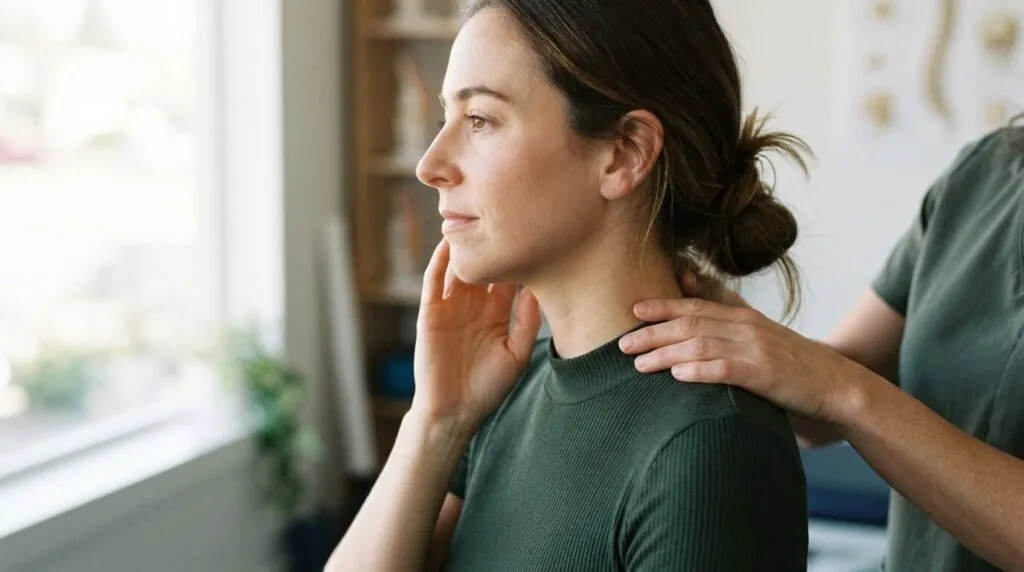
- Manual therapy to the jaw muscles, the joint and the upper neck, including intraoral work on the chewing muscles that can’t be reached from outside. Upper cervical mobilization has been shown in trials to improve jaw pain and mouth opening, with modest effect sizes on its own and better results when combined with jaw treatment. [4, 7]
- Dry needling of overactive chewing and neck muscles such as the masseter, temporalis, upper trapezius and suboccipitals. A network meta-analysis found it reduces pain in muscle-related TMD with results comparable to manual therapy, and in our experience the two together settle the muscle guarding fastest. [8]
- Targeted exercise for jaw control, neck mobility and deep neck muscle endurance.
- Education and habit coaching on jaw rest position, clenching awareness, workstation setup and pacing, which is where most of the long-term results come from.
If your symptoms point to a joint or dental problem that needs other care, we coordinate with your dentist or physician. Every session is 60 minutes, one-on-one with a Doctor of Physical Therapy. Learn more about TMJ physical therapy at Voltex.
7 Things to Try at Home
These are safe starting points for mild symptoms. Stop any that increase your pain.
- Find your jaw’s rest position. Lips together, teeth slightly apart, tongue resting lightly on the roof of your mouth behind your front teeth. Check in on this several times a day.
- Catch the clench. Set a reminder or put a sticker on your monitor. Each time you notice it, return to the rest position.
- Chin tucks. Sitting tall, gently glide your head straight back as if making a double chin. Hold 5 seconds, repeat 10 times, a few times a day.
- Move often. Change position at least every 30 to 45 minutes. Roll your shoulders, turn your head side to side, and look up from your screen.
- Raise your screen. Bring your monitor or phone closer to eye level so your head is not drifting forward for hours. If you work from home in Austin’s tech crowd, this one change does more than any stretch.
- Go easy on the jaw. For a few weeks, choose softer foods, cut food into smaller bites, and skip gum and very chewy foods.
- Use heat. A warm compress on the jaw and neck muscles for 10 to 15 minutes eases tension, especially in the evening.
The jaw rarely hurts alone. Treat the neck it sits on and the habits that load it, and the jaw usually follows.
When to Get Help
Book an evaluation if jaw pain lasts more than two weeks, keeps coming back, limits eating or talking, or comes with neck pain or headaches. Earlier care usually means a faster recovery.
See a physician or dentist promptly if you have jaw pain with chest pain, shortness of breath or pain spreading to the arm (call 911); a jaw that locks open or closed and won’t release; jaw pain after a fall, blow or accident; fever, facial swelling or a tooth that hurts to touch; or new facial numbness, or jaw ache with chewing alongside a new headache and scalp tenderness, especially over age 50.
Frequently Asked Questions
Can a neck problem cause jaw pain even if my jaw is fine?
Yes. Because the upper neck and the jaw share the same relay station in the brainstem, an irritated upper neck can produce pain that you feel in the jaw, temple or face. This is one of the first things we test for, because treating the neck resolves it and treating the jaw doesn’t.
Will fixing my posture cure my TMJ pain?
On its own, rarely. Posture is one contributor among several, and the research doesn’t support it as the single cause. Moving your neck well and changing position often matter more than holding one “correct” posture, and both work better alongside hands-on treatment of the jaw and neck muscles.
Should I keep wearing my night guard?
If your dentist prescribed one, yes, especially if you grind at night. A night guard protects the teeth; it doesn’t change the muscle tension or neck factors that drive the pain, which is where physical therapy comes in. The two work well together.
How many visits does TMD treatment usually take?
Most people notice a change in jaw tension and opening within the first two or three sessions. A typical plan for muscle-related TMD runs four to eight visits, with the home habits above doing much of the work between them.
Work With a TMJ-Focused Physical Therapist in Austin
If your jaw is sore, clicking or tired and your neck is along for the ride, the two are worth treating together. At Voltex Physical Therapy on North Lamar in Austin, we look at the whole picture: jaw, neck, posture and daily habits.
👉 Book a free 15-minute consult, or skip the call and book your first visit online.
This article is for general education and is not a substitute for an individual evaluation.
References
- Armijo-Olivo S, Pitance L, Singh V, Neto F, Thie N, Michelotti A. Effectiveness of manual therapy and therapeutic exercise for temporomandibular disorders: systematic review and meta-analysis. Physical Therapy. 2016;96(1):9–25. https://pubmed.ncbi.nlm.nih.gov/26294683/
- National Academies of Sciences, Engineering, and Medicine. Temporomandibular Disorders: Priorities for Research and Care. Washington, DC: The National Academies Press; 2020. https://nap.nationalacademies.org/catalog/25652
- La Touche R, Martínez García S, Garcia BS, et al. Effect of manual therapy and therapeutic exercise applied to the cervical region on pain and pressure pain sensitivity in patients with temporomandibular disorders: a systematic review and meta-analysis. Pain Medicine. 2020;21(10):2373–2384. Google Scholar
- National Institute of Dental and Craniofacial Research. TMD (Temporomandibular Disorders). https://www.nidcr.nih.gov/health-info/tmd
- Armijo-Olivo S, Rappoport K, Fuentes J, et al. The association between head and cervical posture and temporomandibular disorders: a systematic review. Journal of Orofacial Pain. 2006;20(1):9–23. Google Scholar
- Chaves TC, Turci AM, Pinheiro CF, Sousa LM, Grossi DB. Static body postural misalignment in individuals with temporomandibular disorders: a systematic review. Brazilian Journal of Physical Therapy. 2014;18(6):481–501. Google Scholar
- Lam AC, Liddle LJ, MacLellan CL. The effect of upper cervical mobilization/manipulation on temporomandibular joint pain, maximal mouth opening, and pressure pain thresholds: a systematic review and meta-analysis. Archives of Rehabilitation Research and Clinical Translation. 2023;5(1):100242. https://www.sciencedirect.com/science/article/pii/S259010952200074X
- Menéndez-Torre Á, Pintado-Zugasti AM, Cuenca-Zaldivar JN, et al. Effectiveness of deep dry needling versus manual therapy in the treatment of myofascial temporomandibular disorders: a systematic review and network meta-analysis. Chiropractic & Manual Therapies. 2023;31(1):46. https://link.springer.com/article/10.1186/s12998-023-00489-x