You’ve Tried Everything for Your Headaches. Have You Checked Your Jaw?
You’ve seen your primary care doctor. You’ve tried the preventive medications. You have a prescription for the acute attacks. Maybe you’ve been to a neurologist who confirmed the migraine diagnosis and handed you another prescription. You’ve cut out red wine, identified your triggers, and still — the headaches come.
What almost no one in that treatment chain has asked you is this: how’s your jaw?
It sounds like an odd question. But for a significant percentage of people living with chronic headaches — especially those clustered in the temples, across the forehead, or behind the eyes — the jaw is not just a contributing factor. It may be the primary driver. At Voltex Physical Therapy in Austin, treating the masticatory system and the cervical spine produces headache relief in patients who have been cycling through neurological and pharmacological management for years without resolution.
This article explains why — with the research to back it up.
Dealing with jaw pain in Austin? See how our Doctors of Physical Therapy treat it one-on-one on our TMJ physical therapy in Austin page, or book a free 15-minute consult.
The Numbers Are Striking: TMJ and Headache Almost Always Co-Occur
The relationship between temporomandibular disorders and headache is not anecdotal — it is one of the most consistently documented associations in orofacial pain research. A systematic review and meta-analysis published in 2022, analyzing 31 studies, found that approximately 61.6% of TMD patients also suffer from headaches. In patients with painful TMD specifically, that number climbs to 82.8%.
Migraine is the most commonly associated headache type in TMD populations. The same meta-analysis found that migraines are present in approximately 40% of TMD patients — more than double the rate of tension-type headache. And perhaps most clinically relevant: patients with headaches are nearly four times more likely to have TMD than headache-free controls, with the risk rising even higher in chronic migraine (where the odds ratio reached 24 in some analyses).
Yakkaphan P, et al. (2022). Temporomandibular disorder and headache prevalence: A systematic review and meta-analysis. Cephalalgia Reports. https://journals.sagepub.com/doi/10.1177/25158163221097352
TMD in migraine and tension-type headache patients: a systematic review with meta-analysis. Journal of Oral & Facial Pain and Headache. 2024.
https://www.jofph.com/articles/10.22514/jofph.2024.011
The takeaway: if you have chronic headaches and no one has assessed your jaw and masticatory muscles, you have an incomplete workup. The co-occurrence is too consistent and too well-documented to ignore.
How Your Jaw Actually Causes Head Pain: The Mechanisms
Understanding the jaw-headache connection requires understanding two distinct mechanisms — one muscular, one neurological. Both operate simultaneously in most patients with TMD-related headache, which is why treating either alone rarely produces complete relief.
Mechanism 1: Myofascial Trigger Point Referral
The masseter and temporalis muscles — the two largest jaw closers — have pain referral patterns that project directly into classic headache territory. Trigger points in these muscles don’t just cause local jaw pain. They refer pain to sites that feel exactly like tension headaches or migraines, because the pain is genuinely experienced there through referred neurological pathways.
Here is where each primary masticatory muscle and its associated cervical muscles send their pain:
Temporalis
Refers pain to: The temples (lateral head), the forehead, across the eyebrow, and behind the eye. Can refer into the upper teeth.
The temporalis is the most direct jaw-to-headache muscle. Its trigger points produce pain in exactly the location of the ‘classic tension headache’ or the lateral headache of migraine. Patients frequently describe their TMD headache as feeling ‘right at the temples’ — this is temporalis referral.
Masseter (Superficial Head)
Refers pain to: The cheek, the upper and lower teeth, the ear, and the maxillary sinus region. Can refer over the eyebrow.
The superficial masseter is responsible for the cheek-and-eye region headache pattern. When patients describe a ‘heavy’ feeling across the cheekbone or a sensation of sinus pressure without sinus pathology, masseter trigger points are frequently the source.
Masseter (Deep Head)
Refers pain to: Deep in the ear and the TMJ region, and sometimes into the occipital area at the base of the skull.
The deep masseter head contributes to the ear-and-jaw aching pattern common in TMD. When occipital referral is present, it bridges the jaw and the classic tension headache distribution at the back of the head.
Sternocleidomastoid (SCM)
Refers pain to: The forehead, behind the eye, the crown of the head, the ear, and the jaw region.
The SCM has one of the most clinically significant — and most commonly missed — referral patterns in the body. It refers pain into nearly every location associated with headache. SCM trigger points are almost universally present in patients with TMD-associated headache, yet the muscle is rarely assessed in neurological headache workups.
Upper Trapezius
Refers pain to: The temple region, the lateral neck, and behind the ear.
Upper trapezius trigger point referral into the temple directly overlaps with the location of ‘tension-type headache.’ In TMD patients with forward head posture, the upper trapezius is chronically overloaded and consistently active.
Suboccipital Group
Refers pain to: A band of pain from the occiput around the side of the head toward the eye — the ‘hat band’ pattern.
Suboccipital trigger points and C0–C2 joint restriction produce the circumferential headache pattern patients often describe as ‘a band around my head.’ This is one of the most common cervicogenic headache presentations and is directly linked to TMD through shared upper cervical neurology.
Characteristics of referred muscle pain from active trigger points in women with myofascial TMD. PMC.
https://www.ncbi.nlm.nih.gov/pmc/articles/PMC3484251/
Is painful TMD a real headache for many patients? British Dental Journal. 2024.
https://www.nature.com/articles/s41415-024-7178-1
Mechanism 2: The Trigeminocervical Nucleus — Where Jaw Pain Becomes Head Pain
The second mechanism is neurological and operates at the level of the brainstem. The trigeminal nerve (CN V) carries sensory information from the jaw, the face, the teeth, and the TMJ. The upper cervical spinal nerves (C1–C3) carry information from the neck, the occiput, and the upper cervical joints. These two inputs converge on the same neurons in the trigeminal cervical nucleus — a relay center in the brainstem.
When either system is sensitized — by jaw muscle overload, TMJ inflammation, or upper cervical joint restriction — it lowers the activation threshold of the shared neurons. This means that input from the jaw can be processed as head pain, and input from the cervical spine can be experienced as facial pain. The brain doesn’t always correctly identify the source.
This neurological convergence is why:
Jaw dysfunction can produce genuine forehead, temple, and eye pain without any pathology in those structures
Cervical joint restriction at C1–C2 can produce jaw aching and facial pain
Treating the jaw can reduce headache frequency even in patients with established migraine diagnoses
Patients with both TMD and migraine have a far more sensitized system than those with either condition alone — which is why their headaches are often more frequent and more severe
Neural Basis of Etiopathogenesis and Treatment of Cervicogenic Orofacial Pain. PMC. 2022.
https://pmc.ncbi.nlm.nih.gov/articles/PMC9611820/
The most important clinical implication of trigeminocervical convergence: in a patient with both jaw dysfunction and chronic headache, the two conditions are not simply co-occurring — they are amplifying each other. Both need to be treated for either to fully resolve.
Headache Attributed to TMD: The Formally Recognized Diagnosis That’s Still Being Missed
The international research community has formally recognized the jaw-headache connection by establishing Headache Attributed to TMD (HATMD) as a distinct diagnostic category in both the Diagnostic Criteria for Temporomandibular Disorders (DC/TMD) and the International Classification of Headache Disorders (ICHD-III).
HATMD is defined as a headache in the temple region that is:
Aggravated or modified by jaw movement, function, or parafunctional behaviors (clenching, chewing, talking)
Reproduced or provoked by palpation of the temporalis or masseter muscles by the examiner
Temporally related to the onset or worsening of a TMD diagnosis
This is a specific, testable, reproducible diagnosis. If a clinician presses on your temporalis muscle and reproduces your familiar headache, that is HATMD by definition — and it points directly to the jaw and masticatory musculature as the primary driver.
The problem is that HATMD is systematically underdiagnosed. Patients with this presentation are typically routed to neurology, given migraine or tension-type headache diagnoses, and managed pharmacologically. The jaw is never assessed. The temporalis is never palpated. The masticatory muscles are not in the standard neurological or primary care exam — so a condition driven by those muscles goes unidentified until a provider who knows to look for it actually looks.
Is painful TMD a real headache for many patients? British Dental Journal. 2024.
https://www.nature.com/articles/s41415-024-7178-1
Ultrasonographic examination of masticatory muscles in patients with TMJ arthralgia and HATMD. Scientific Reports. 2024.
https://www.ncbi.nlm.nih.gov/pmc/articles/PMC11026518/
The diagnostic test for HATMD that every headache patient should know: can your examiner reproduce your familiar headache by pressing on the temporalis or masseter? If yes, your jaw is involved in your headache — regardless of what diagnosis you’ve been given.
How to Know If Your Headaches Are Jaw-Driven
Not every headache is TMD-related, and we’re not suggesting that every headache patient should be diverted away from neurological care. But certain patterns strongly suggest jaw and cervical involvement as a primary or significant contributor. Here is what to look for:
Patterns That Point to the Jaw
Headaches that are consistently worse in the morning — coinciding with morning jaw pain and stiffness from nocturnal bruxism
Headaches that worsen during or immediately after prolonged chewing, talking, or jaw use
Headaches that worsen during periods of high stress — when jaw clenching increases
Temple headaches that are also present alongside jaw tightness, clicking, or facial tension
Headaches that improve when the jaw muscles are warmed up or massaged
A history of jaw clicking, locking, or jaw pain alongside the headache pattern
Headaches that began around the same time as a dental procedure, jaw injury, or period of significant stress
Patterns That May Indicate a Primary Headache Disorder WITH Jaw Involvement
It’s important to note that primary headache disorders (migraine, tension-type headache) and HATMD are not mutually exclusive. A 2022 meta-analysis confirmed that the two conditions are bidirectionally associated — meaning TMD can trigger and amplify migraine, and migraine can sensitize the system in ways that worsen TMD. Patients with both conditions need both addressed.
If you have a confirmed migraine or tension-type headache diagnosis and your medication management is incomplete — meaning the headaches still break through or the preventives are not fully effective — jaw and cervical spine assessment should be the next clinical step, not a higher medication dose.
Romero-Reyes M, Bassiur JP. (2024). Temporomandibular Disorders, Bruxism and Headaches. Neurologic Clinics, 42(2):573–584.
How We Treat TMJ-Related Headaches at Voltex PT in Austin
At Voltex Physical Therapy in Austin, we approach TMD-related headache the same way we approach every jaw presentation: as a whole-system problem that requires a whole-system treatment. For headache patients specifically, that means an integrated approach targeting the masticatory muscles, the cervical spine, and the postural chain — all of which contribute to the headache picture, often simultaneously.
Dry Needling: Deactivating the Trigger Points Sending Pain to Your Head
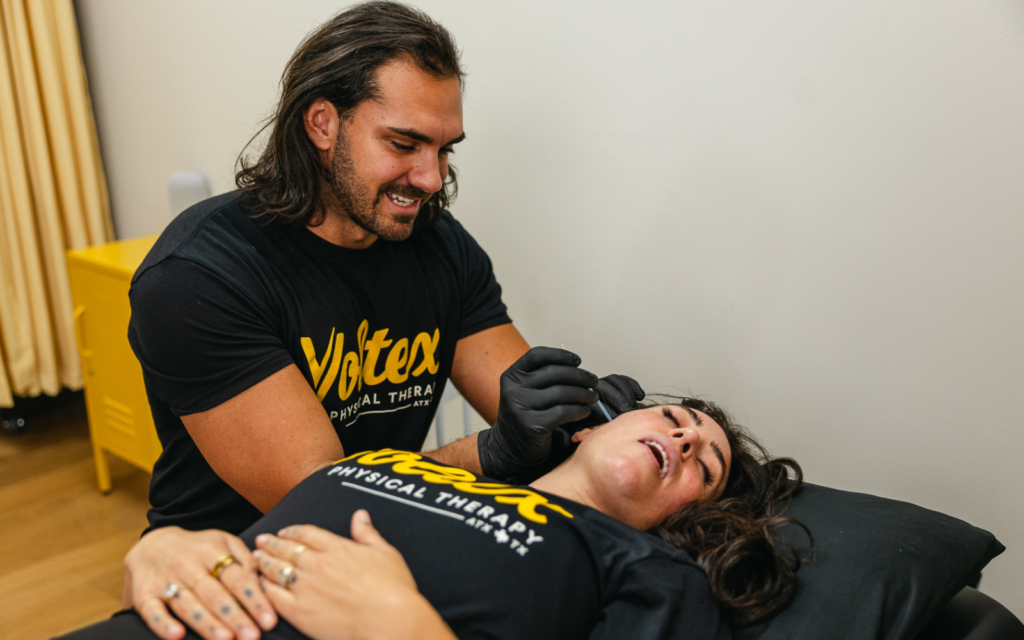
The most direct treatment for myofascial headache driven by TMD is trigger point dry needling of the muscles producing the referral. For temple and forehead headaches, we needle the temporalis — systematically working through the anterior, middle, and posterior fibers to deactivate the trigger points projecting pain into those regions. For cheek and eye-region pain, the masseter (both superficial and deep heads) is the primary target.
For patients with additional cervical contributions to their headache — which is nearly universal — we also needle the SCM, suboccipital group, upper trapezius, and splenius capitis. Each of these muscles has a well-documented referral pattern into headache territory, and each needs to be addressed for comprehensive headache relief.
Patients frequently report reduction in headache frequency and intensity within the first few sessions of targeted dry needling. This is not placebo — it reflects the resolution of active trigger points that were genuinely generating the pain experience in the head.
Manual Therapy: Restoring the Cervical Mechanics Amplifying Your Headaches
Beyond the muscles, cervical joint restriction — particularly at C0–C1 and C1–C2 — directly contributes to headache via the trigeminocervical nucleus. We use Maitland-grade joint mobilization of the upper cervical spine to restore normal motion, reduce joint irritability, and lower the background neurological noise that is sensitizing the headache system. In patients with combined TMD and headache, this is often the intervention that produces the most sustained long-term reduction in headache frequency.
TMJ-specific manual therapy — joint distraction, lateral glides, and intraoral muscle work — reduces the joint loading and muscular tension feeding into the trigeminocervical system from the jaw side.
Postural Correction: Addressing the Driver Behind the Driver
Forward head posture is the dominant postural fault in Austin’s tech and desk-working population, and it loads both the cervical spine and the jaw simultaneously. For every centimeter of forward head translation, the effective weight on the cervical spine increases — amplifying the compressive forces feeding into the suboccipital musculature, the upper traps, the SCM, and the TMJ through the hyoid chain. Correcting this pattern through deep cervical flexor retraining, thoracic mobility work, and scapular stabilization removes one of the most consistent structural contributors to both TMD and headache in our Austin patient population.
Patient Education: Understanding Your Headache Triggers
For TMD-related headache patients, understanding the connection between jaw behavior and headache onset is therapeutically powerful. Patients who understand that their temple headache follows a night of bruxism, or that their afternoon headache correlates with stress-driven clenching at the desk, are in a position to interrupt the pattern — not just treat the consequence. We provide specific guidance on:
Jaw awareness during high-stress periods: teeth should rest apart, tongue on the palate, lips closed
Identifying parafunctional clenching during exercise, driving, or concentration-heavy tasks
Sleep position and pillow height, which directly affect cervical compression and headache patterns
Timing of headache relative to jaw activity — keeping a simple log that helps identify the trigger chain
Khayamzadeh M, Razmara F, Tavassoli A. (2025). Dry Needling in Treatment of Temporomandibular Joint Disorders: A Systematic Review. Clin Exp Dent Res. PMID:40917038.
Vieira LS, et al. (2023). The Efficacy of Manual Therapy Approaches in Temporomandibular Disorders: Systematic Review of 20 RCTs. Life. 13(2):292.
https://doi.org/10.3390/life13020292
At Voltex PT in Austin, headache patients with suspected jaw involvement receive a full assessment of the TMJ, masticatory muscles, cervical spine, and postural chain — not just the jaw in isolation. The treatment targets every structure contributing to the headache pattern, which is why outcomes are durable rather than temporarily symptomatic.
Frequently Asked Questions: TMJ Headaches in Austin
Can a jaw problem really cause migraines?
Yes — in two ways. First, trigger points in the temporalis and masseter refer pain directly into migraine territory — the temple, the forehead, and behind the eye. This referred pain is processed by the brain as headache regardless of its actual muscular origin. Second, TMD sensitizes the trigeminocervical nucleus, which lowers the threshold for migraine activation. Treating the jaw can reduce migraine frequency even when the headache itself is a true neurological migraine, because you’re reducing the peripheral sensitization that is triggering it.
How do I know if my headache is from my jaw or a ‘real’ migraine?
The most reliable clinical test: if palpation of your temporalis or masseter reproduces your familiar headache, the jaw is involved by definition. That doesn’t mean you don’t also have a primary headache disorder — both can coexist — but it does mean the jaw is contributing and needs treatment. Jaw-driven headaches also tend to correlate with jaw use (worse after chewing, talking, stress-clenching) and are often worst in the morning following nocturnal bruxism.
My neurologist said my headaches are migraines. Should I stop my medication?
Absolutely not — and we’re not suggesting you should. Physical therapy for TMD and headache is additive to neurological management, not a replacement for it. In patients with both TMD and confirmed migraine, treating the jaw and cervical spine frequently improves medication response and reduces breakthrough headaches. The goal is to reduce the peripheral load that is triggering the migraine cascade, making your existing treatment more effective.
Will treating my TMJ completely stop my headaches?
For patients whose headache is primarily HATMD — meaning the jaw is the main driver — yes, comprehensive TMD treatment can resolve the headache pattern entirely. For patients with co-occurring primary headache disorder and TMD, treating the jaw typically reduces headache frequency and severity significantly, sometimes dramatically, but doesn’t always eliminate every headache event. The more TMD-specific features are present in the headache pattern (morning worse, jaw-use correlated, temporalis palpation positive), the higher the response to jaw treatment.
Where is Voltex PT located in Austin?
We’re at 5555 N Lamar Blvd, Suite C105, Austin, TX 78751 — on the North Lamar corridor, easily accessible from Hyde Park, North Loop, Rosedale, The Triangle, and Central Austin. Street parking available.
Your Headaches May Have a Source Your Doctors Missed. Let’s Find It.
If you’ve been treating your headaches pharmacologically for months or years without complete resolution — and if your headaches cluster in the temples, follow jaw use, or correlate with morning jaw pain — your jaw deserves a proper clinical assessment. At Voltex PT in Austin, we’ve helped patients reduce or resolve headaches that had been misattributed and mismanaged for years, simply by treating the masticatory and cervical system correctly.
The jaw is not outside the scope of physical therapy. It is exactly where physical therapy has some of its most powerful and most underutilized clinical impact.
References
1. Yakkaphan P, et al. (2022). Temporomandibular disorder and headache prevalence: A systematic review and meta-analysis. Cephalalgia Reports.
https://journals.sagepub.com/doi/10.1177/25158163221097352
2. TMD in migraine and tension-type headache patients: systematic review with meta-analysis. J Oral Facial Pain Headache. 2024.
https://www.jofph.com/articles/10.22514/jofph.2024.011
3. Romero-Reyes M, Bassiur JP. (2024). Temporomandibular Disorders, Bruxism and Headaches. Neurologic Clinics, 42(2):573–584.
https://pubmed.ncbi.nlm.nih.gov/38575267/
4. Is painful TMD a real headache for many patients? British Dental Journal. 2024.
https://www.nature.com/articles/s41415-024-7178-1
5. Ultrasonographic examination of masticatory muscles in TMJ arthralgia and HATMD. Scientific Reports. 2024.
https://www.ncbi.nlm.nih.gov/pmc/articles/PMC11026518/
6. Neural Basis of Etiopathogenesis and Treatment of Cervicogenic Orofacial Pain. PMC. 2022.
https://pmc.ncbi.nlm.nih.gov/articles/PMC9611820/
7. Characteristics of referred muscle pain from active trigger points in women with myofascial TMD. PMC.
https://www.ncbi.nlm.nih.gov/pmc/articles/PMC3484251/
8. Vieira LS, et al. (2023). The Efficacy of Manual Therapy Approaches in TMD: Systematic Review of 20 RCTs. Life. 13(2):292.
https://doi.org/10.3390/life13020292
9. Khayamzadeh M, Razmara F, Tavassoli A. (2025). Dry Needling in TMJ Disorders: A Systematic Review. Clin Exp Dent Res. PMID:40917038.
10. Exposto FG, et al. (2025). Prevalence of Painful TMD and Overlapping Primary Headaches Among Young Adults. European Journal of Pain.
https://onlinelibrary.wiley.com/doi/10.1002/ejp.70013