Is Your Jaw Pain Running Your Life? You’re Not Alone in Austin.
If you’ve been living with jaw pain, relentless headaches, clicking or locking when you eat, or tension that radiates from your face into your neck and shoulders — you already know how exhausting TMJ dysfunction can be. Temporomandibular joint (TMJ) disorders affect an estimated 5–10% of the adult population, and here in Austin, TX, we see patients dealing with this every single day.
Whether you’re a South Congress-area professional grinding your teeth through back-to-back Zoom calls, a North Loop cyclist clenching your jaw on long rides, or a student at UT Austin waking up with facial pain and ear fullness — TMJ dysfunction doesn’t discriminate. And unfortunately, neither does bad advice.
If you’ve been told that Botox injections are your best option — or your only option — we want you to have the full picture. At Voltex Physical Therapy on North Lamar in Austin, we see patients every week who found real, lasting relief through hands-on physical therapy and dry needling after cycling through injections that only provided temporary relief. This article breaks down what the science actually says, from PubMed-indexed research, comparing manual therapy and dry needling to Botox for TMJ. Our goal isn’t to scare you away from any one treatment — it’s to make sure you’re making decisions with the full evidence in hand.
Dealing with jaw pain in Austin? See how our Doctors of Physical Therapy treat it one-on-one on our TMJ physical therapy in Austin page, or book a free 15-minute consult.
What Is TMJ Dysfunction — And Why Is It So Common in Austin?
The temporomandibular joint connects your jawbone to your skull on each side of your face. It’s involved in every bite, word, and yawn you take. TMJ disorders (TMD) are a broad category of conditions involving the joint itself, the muscles of mastication (chewing), surrounding connective tissue, or some combination of all three.
Austin’s active, high-achieving culture — long work hours, high-intensity fitness culture, chronic stress, and a thriving restaurant and social scene — creates a perfect environment for TMJ dysfunction to develop and persist. Add in the prevalence of tech jobs with poor ergonomics, endurance sports like running and cycling along the Greenbelt or Town Lake, and the general stress load of a fast-growing city, and it’s no surprise that TMJ pain is one of the most common complaints we treat at Voltex PT.
Common TMJ symptoms include:
Jaw pain or facial pain, especially with chewing or talking
Clicking, popping, or grinding sensations in the jaw
Limited mouth opening or jaw locking
Headaches and temple pain
Ear pain or a sensation of fullness in the ears
Neck stiffness and upper back tension
Teeth grinding (bruxism), often worse during periods of stress
The root causes of TMD are multifactorial and often include muscular hypertonicity (trigger points in the jaw and neck muscles), cervical spine dysfunction, poor posture, bite irregularities, stress, and trauma. This is a critical point: TMD is not simply a joint problem — it is frequently a neuromuscular problem. And that distinction matters enormously when choosing treatment.
Manual Therapy for TMJ in Austin: What the Research Says
Manual therapy — which includes joint mobilization, soft tissue work, cervical spine treatment, and myofascial techniques — has a growing and robust evidence base for treating TMJ disorders. At Voltex Physical Therapy in Austin, manual therapy is a cornerstone of how we approach jaw dysfunction. Let’s look at the data.
High-Quality Evidence Across 20 Randomized Controlled Trials
A 2023 systematic review published in Life (MDPI) analyzed 20 randomized controlled trials (RCTs) and found that manual therapy produced significant improvements in pain intensity — with high and moderate quality evidence demonstrating meaningful reductions at both short-term and long-term follow-up on a 0–10 pain scale. Improvements in maximum mouth opening (MMO) and disability were also documented.
Vieira et al. (2023). The Efficacy of Manual Therapy Approaches on Pain, Maximum Mouth Opening and Disability in Temporomandibular Disorders: A Systematic Review of Randomised Controlled Trials. Life, 13(2), 292. https://doi.org/10.3390/life13020292
This is not a small or low-quality body of evidence. Twenty RCTs, reviewed with GRADE methodology, showing consistent results across pain and function outcomes — that’s meaningful clinical data that informs how we treat TMJ patients in our Austin clinic.
Manual Therapy Outperforms Botox Head-to-Head
A systematic review and meta-analysis published in PLOS One (2024) compared botulinum toxin (BTX) directly against manual therapy and found that BTX was actually less effective than facial manipulation for pain reduction at 3 months. Read that again: the research shows hands-on physical therapy outperforms Botox when it comes to medium-term outcomes — the timeframe that matters most for patients seeking lasting change.
Effectiveness of Botulinum Toxin for Temporomandibular Disorders: A Systematic Review and Meta-Analysis. PLOS One, 2024. https://doi.org/10.1371/journal.pone.0300157
Combining Manual Therapy With PT Education Produces Superior Results
A 2024 randomized controlled trial confirmed that combining manual therapy with physical therapy and patient education produces superior outcomes compared to home physical therapy alone — with significant improvements in jaw mobility and pain reduction. This multimodal model is exactly what Austin TMJ patients receive at Voltex PT.
Shah et al. (2024). Effectiveness of Manual Therapy, Physical Therapy in Conjunction with Patient Education for Temporomandibular Disorders. JAMC, 36(2), 373–379. PMID:39609984
The Austin Neck Connection: Why Cervical Spine Treatment Matters for TMJ
One area that is chronically undertreated in standard TMJ care is the cervical spine — and this is especially relevant for the Austin population of desk workers, cyclists, and endurance athletes. A systematic review and meta-analysis (2023) analyzed 8 RCTs with 437 participants and found that upper cervical joint mobilization and manipulation effectively reduced TMJ pain and improved mouth opening. The jaw and neck are biomechanically linked — treating one without the other often leaves results on the table.
The Effect of Upper Cervical Mobilization/Manipulation on Temporomandibular Joint Pain, Maximal Mouth Opening, and Pressure Pain Thresholds: A Systematic Review and Meta-Analysis. PMC, 2023. https://pmc.ncbi.nlm.nih.gov/articles/PMC10036235/
At Voltex PT in Austin, we treat the whole system — not just the jaw. Our approach integrates cervical spine treatment, hands-on manual therapy to the jaw and surrounding musculature, and corrective movement patterns to address the root cause of your TMJ pain.
Dry Needling for TMJ in Austin, TX: Targeting the Trigger Points That Drive Your Pain
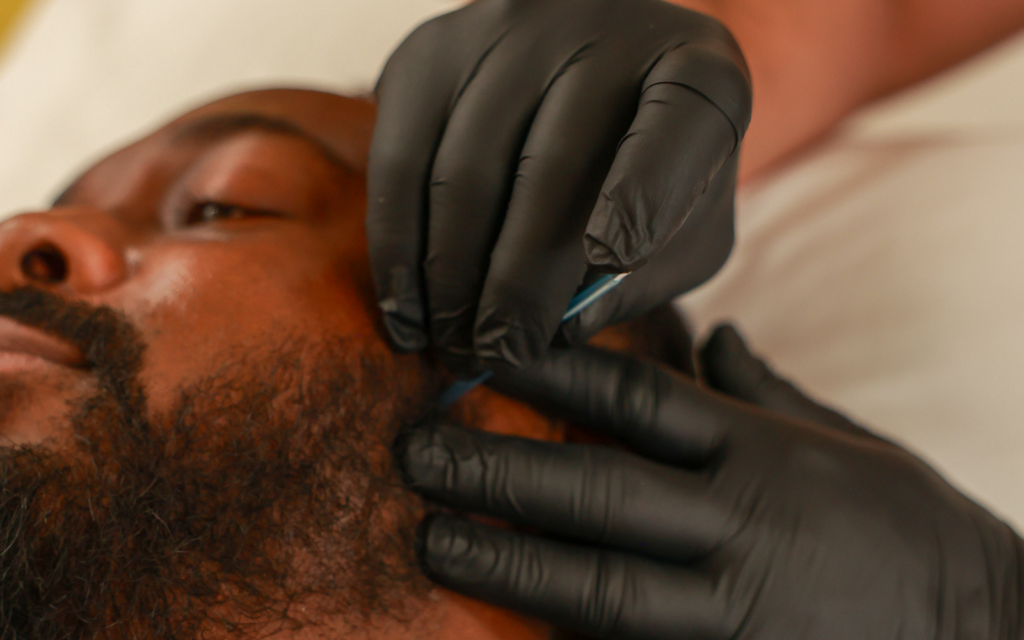
Dry needling is one of the most powerful and direct tools we use at Voltex Physical Therapy for TMJ dysfunction — and the research is catching up to what we see clinically every day in our Austin patients. Trigger point dry needling (TDN) involves inserting a thin monofilament needle directly into myofascial trigger points to elicit a local twitch response, release the trigger point, and restore normal neuromuscular function.
In TMD, the masseter, temporalis, medial and lateral pterygoid, and sternocleidomastoid muscles are frequently loaded with trigger points that refer pain into the face, head, and ears — mimicking everything from ear infections to migraines. These are exactly the muscles we target with dry needling at our North Austin clinic. Standard pain management and even many dental approaches rarely address these underlying muscular drivers.
2025 Systematic Review: Dry Needling Works for TMJ
A comprehensive 2025 systematic review published in Clinical and Experimental Dental Research (PubMed-indexed) reviewed 10 clinical trials on dry needling for TMD. The findings were clear:
Dry needling produced significant reductions in VAS (visual analog scale) pain scores across multiple studies
One study reported pain scores dropping from 8.3 to 2.3 out of 10 following dry needling to the masseter region
Another study documented a 63.51% reduction in pain and 57.09% reduction in trigger point quantity in the dry needling group
Improvements were noted in jaw mobility, mandibular range of motion, and muscle function
Khayamzadeh, Razmara, Tavassoli (2025). Dry Needling in Treatment of Temporomandibular Joint Disorders: A Systematic Review. Clin Exp Dent Res. doi:10.1002/cre2.70214. PMID:40917038
Dry Needling + Manual Therapy: The Combination That Works
The same 2025 review highlighted research by Dunning et al. (2024), which found that dry needling combined with spinal manipulation produced superior pain relief and mouth opening compared to splint therapy, pharmacological management, and non-thrust joint mobilization at 3-month follow-up. This combined approach mirrors exactly what we do at Voltex PT — because it reflects what the evidence supports.
Dry needling doesn’t just reduce pain in the moment. It resets the neuromuscular system, reduces muscle hypertonicity, improves local blood flow, and — when combined with manual therapy and corrective exercise — addresses the underlying dysfunction that was generating the pain in the first place. That’s how Austin TMJ patients get better and stay better.
Dry needling at Voltex PT is performed by clinicians with specialized post-graduate training in trigger point dry needling. We treat the jaw, neck, and surrounding musculature as an integrated system — not in isolation.
The Truth About Botox for TMJ Pain: Temporary Relief With Real Trade-Offs
We want to be fair: Botox isn’t without merit. For certain patients — particularly those who have exhausted conservative care or need short-term relief to participate in active therapy — Botox can offer temporary symptom management. But if you’re searching for TMJ treatment in Austin and you want to understand your options fully, there is a critical difference between managing symptoms and resolving the problem.
Here’s what the research and clinical reality tell us about Botox as a long-term TMJ strategy:
The Evidence Is Inconsistent — and Doesn’t Favor Botox
A systematic review and meta-analysis in PLOS One (2024) — one of the largest and most rigorous reviews on the topic — concluded that BTX was not associated with better outcomes compared to placebo or other treatments for pain reduction, mouth opening, bruxism, or occlusal force. The study included 14 RCTs and 395 patients and found no significant advantage for Botox over comparison treatments.
Effectiveness of Botulinum Toxin for Temporomandibular Disorders: A Systematic Review and Meta-Analysis. PLOS One, 2024. https://doi.org/10.1371/journal.pone.0300157
A separate systematic review of BTX-A found it was only slightly more effective than placebo at 1 month — and by 3 and 6 months, there were no significant differences compared to placebo or no treatment. Meanwhile, facial manipulation (manual therapy) outperformed Botox at 3 months head-to-head.
Machado et al. (2020). Botulinum Toxin Type A for Painful Temporomandibular Disorders: Systematic Review and Meta-Analysis. PMID:31513934
Botox Does Not Fix the Problem — It Temporarily Paralyzes It
This is the most important thing to understand about Botox for TMJ: it works by temporarily paralyzing the injected muscles. The masseter, temporalis, or pterygoid muscles stop contracting forcefully — and that’s what produces pain relief. But when the effect wears off (typically in 3 months), those muscles wake back up, and so does the pain.
The underlying neuromuscular dysfunction — the trigger points, the postural imbalances, the altered movement patterns, the cervical spine involvement — was never addressed. Nothing was corrected. Nothing was healed. You simply waited out the paralysis and came back for another round.
Many Austin residents end up in this cycle: Botox in December, relief for a few months, pain returns in spring, repeat. Without treating the neuromuscular root cause, there’s no endpoint to the treatment — just a recurring appointment and a recurring bill.
The Repeat Injection Cycle: The Hidden Cost of Botox for Austin TMJ Patients
Botox effects for TMJ typically last 3 to 4 months. That means most patients who rely on Botox for jaw pain require 3 to 4 injection cycles per year — indefinitely — to maintain relief.
Here’s what that actually looks like financially and practically for Austin patients:
A single Botox TMJ session typically runs $500–$1,500 out of pocket — it is not covered by most health insurance plans for TMD
At 3–4 sessions per year, patients spend $1,500–$6,000+ annually, every year, simply to manage ongoing symptoms
Each injection is a procedure: scheduling, commuting across Austin traffic, office time, recovery period, and the injections themselves
There is no discharge date, no finish line — because the underlying cause was never addressed
By contrast, a course of physical therapy at Voltex PT in Austin is time-limited, goal-oriented, and designed to discharge you when you no longer need us. Our model is built around getting you better — not keeping you on the books. One-on-one care, every session, from a doctoral-level physical therapist.
Muscle Atrophy and Bone Loss: Risks Austin Patients Are Rarely Told About
Repeated Botox injections into the masseter muscle carry risks that are still being studied — and that are not widely communicated to patients at the point of injection. Because Botox temporarily paralyzes muscle, the affected muscles atrophy (shrink and weaken) over time with repeated use.
Multiple studies — including animal research and preliminary human data — have documented mandibular bone loss following repeated masseter Botox injections. Bone is a dynamic tissue that depends on muscle loading to stay healthy and dense. When the masseter is repeatedly paralyzed, the mechanical stimulus that maintains bone density is removed — and bone resorption can follow.
NYU College of Dentistry (2020). Botox for TMJ Disorders May Not Lead to Bone Loss in the Short Term, But More Research is Needed on Higher Dose, Long-Term Use. Journal of Oral Rehabilitation.
The TMJ Association. Repeated Injections of Botox in the Masseter Muscle: A Longitudinal Study. https://tmj.org/repeated-injections-of-botox-in-the-masseter-muscle-a-longitudinal-study/
Even conservative researchers have called for further long-term clinical studies before committing patients to repeat Botox cycles — noting that the benefit-to-risk profile has not been adequately established for ongoing use.
The bottom line: Botox temporarily quiets the muscles that hurt. When it wears off, the problem comes back — and repeated use carries real risks to jaw muscle integrity and bone health. It’s a band-aid, not a cure.
TMJ Manual Therapy + Dry Needling vs. Botox: Side-by-Side
Manual Therapy + Dry Needling at Voltex PT — Austin, TX
Addresses the root neuromuscular cause of TMD — not just the symptom
Durable improvements at 3, 6, and 12 months across multiple high-quality RCTs
Treats trigger points, joint restriction, cervical spine dysfunction, and movement patterns
Time-limited, goal-oriented treatment — you get discharged when you’re better
No paralysis, no muscle atrophy, no bone loss risk
One-on-one care with a doctoral-level PT every single session
Often HSA/FSA-eligible; builds self-management skills to prevent recurrence
Botox Injections for TMJ
Temporarily paralyzes jaw muscles to reduce pain — does not address root cause
Effects last 3–4 months; 3–4 repeat injections required per year, indefinitely
Research shows no significant advantage over placebo at 3 and 6 months
Less effective than manual therapy at 3 months in head-to-head RCT data
Risks include progressive muscle atrophy and jaw bone density loss with repeated use
Typically $500–$1,500+ per session, not covered by insurance for TMD
No treatment endpoint — patients become reliant on ongoing injections
Frequently Asked Questions: TMJ Treatment in Austin, TX
Is dry needling for TMJ painful?
Most patients describe a brief, dull ache or a muscle twitch sensation during treatment — not sharp pain. Dry needling for TMJ is well-tolerated, and many patients notice significant relief within the first 1–2 sessions. Our Austin clinicians are trained in post-graduate dry needling techniques and will communicate with you throughout every step of treatment.
How is physical therapy for TMJ different from seeing a dentist or getting Botox?
A dentist typically focuses on bite alignment, occlusal splints, and dental hardware. Botox targets muscular pain through temporary paralysis. Physical therapy at Voltex PT addresses the neuromuscular system — the muscles, joints, movement patterns, and postural contributors that are actually driving your symptoms. It’s the only approach that actively rehabilitates the system rather than managing symptoms around it.
How many sessions will I need for TMJ at Voltex PT in Austin?
It varies by patient, but many people see meaningful improvement within 4–8 sessions. We’ll give you an honest assessment at your first visit and a clear plan — including realistic goals and an expected timeline. We don’t keep patients in care longer than they need to be.
Do you accept insurance at Voltex Physical Therapy?
Voltex PT is a cash-based clinic, meaning we do not bill insurance directly. However, many patients use HSA or FSA accounts to cover treatment costs. We’re also happy to provide a superbill for potential out-of-network reimbursement. The advantage of our cash-based model is that your care is never dictated by what an insurance company will authorize — it’s dictated by what you actually need.
Where is Voltex PT located in Austin?
We’re located at 5555 N Lamar Blvd, Suite C105, Austin, TX 78751 — easily accessible from Hyde Park, The Triangle, North Loop, Rosedale, and the 183 corridor. Street parking is available, and we’re right on the North Lamar corridor that connects central and north Austin.
Ready to Actually Fix Your Jaw Pain? Visit Voltex PT in Austin.
If you’re in Austin and dealing with TMJ pain, jaw clicking, bruxism, chronic headaches, or facial tension — we’d love to sit down with you. Whether you’ve tried Botox, a night guard, or nothing at all, we’ll give you an honest evaluation, a real diagnosis, and a treatment plan built around your goals — not a generic protocol.
Austin deserves physical therapy that goes beyond symptom management. At Voltex PT, that’s all we do.
References
Vieira LS, et al. (2023). The Efficacy of Manual Therapy Approaches on Pain, Maximum Mouth Opening and Disability in Temporomandibular Disorders. Life. 13(2):292. doi:10.3390/life13020292
Shah SU, et al. (2024). Effectiveness of Manual Therapy, Physical Therapy in Conjunction with Patient Education for Temporomandibular Disorders. JAMC. 36(2):373–379. PMID:39609984
Upper Cervical Mobilization/Manipulation on TMJ Pain: Systematic Review and Meta-Analysis. PMC. 2023. https://pmc.ncbi.nlm.nih.gov/articles/PMC10036235/
Gebska M, et al. (2023). Evaluation of the Efficacy of Manual Soft Tissue Therapy and Therapeutic Exercises in Patients with Pain and Limited Mobility TMJ: A Randomized Control Trial. Head Face Med. doi:10.1186/s13005-023-00385-y
Khayamzadeh M, Razmara F, Tavassoli A. (2025). Dry Needling in Treatment of Temporomandibular Joint Disorders: A Systematic Review. Clin Exp Dent Res. doi:10.1002/cre2.70214. PMID:40917038
Effectiveness of Botulinum Toxin for Temporomandibular Disorders: A Systematic Review and Meta-Analysis. PLOS One. 2024. doi:10.1371/journal.pone.0300157
Machado E, et al. (2020). Botulinum Toxin Type A for Painful Temporomandibular Disorders: Systematic Review and Meta-Analysis. PMID:31513934
NYU College of Dentistry. (2020). Botox for TMJ Disorders May Not Lead to Bone Loss in the Short Term, But More Research is Needed. Journal of Oral Rehabilitation.
The TMJ Association. Repeated Injections of Botox in the Masseter Muscle: A Longitudinal Study. https://tmj.org/repeated-injections-of-botox-in-the-masseter-muscle-a-longitudinal-study/
Botulinum Toxin for Temporomandibular Disorders: Clinical Effectiveness, Cost-Effectiveness, and Guidelines. CADTH Rapid Response Reports. 2020. PMID:33074614