The Protocol Everyone Knows — and Why It Needs an Update
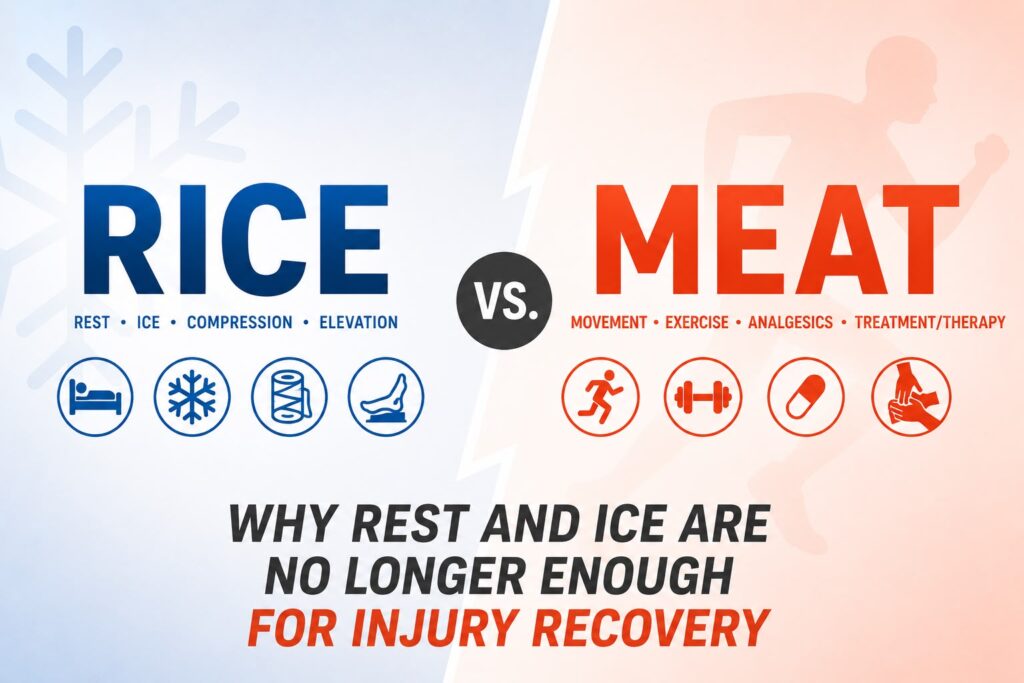
RICE. Rest, Ice, Compression, Elevation. If you’ve ever sprained an ankle, pulled a muscle, or taken a hit in a contact sport, there’s a good chance someone told you to follow this protocol. It has been the default first-response framework for acute soft tissue injuries for decades — passed down from athletic trainers to coaches to parents to gym-goers as though it were settled science.
The problem is that it isn’t. RICE was never built on high-quality clinical evidence, and the research that has accumulated since — particularly in the past five years — has substantially weakened the case for its key components. Rest and ice, in particular, have been shown to offer limited benefit for functional recovery and, in some contexts, may actually slow it down.
This matters because how you manage the first 24–72 hours after an injury has a meaningful impact on how quickly and completely you recover. Getting that window right — or wrong — changes your trajectory. At Voltex Physical Therapy in Austin, we want our patients and the broader Austin active community to understand what the evidence actually says, so they can make better decisions the moment an injury happens.
The short answer: RICE was never based on high-quality evidence. Its individual components — particularly rest and ice — offer little benefit for functional recovery and may actually impede healing by blunting the inflammatory response that drives tissue repair
Breaking Down RICE: What the Evidence Actually Shows
Let’s go through each component of RICE and look at what the research actually supports — not what we assumed for the last 40 years.
R — REST | Outdated for most injuries
Prolonged immobilization and complete rest have no demonstrated role in reducing pain or promoting healing for soft tissue injuries — and can actively work against recovery. Muscular degeneration begins within days of disuse. Joint mechanics deteriorate. Neuromuscular control fades. These are changes that then become their own rehabilitation problems, layered on top of the original injury.
The American Academy of Family Physicians (2025) now notes that rigid immobilization — splints, walking boots — should be avoided beyond approximately 10 days for most ankle sprains to prevent muscular degeneration. Early, protected weight-bearing and functional movement produce more favorable outcomes than rest. The key word is protected: we’re not advocating for playing through pain or ignoring tissue healing timelines, but for replacing total rest with active, graduated loading as soon as the injury pattern allows.
I — ICE | Analgesic only — does not improve recovery
This is the component where the evidence has shifted most dramatically. The physiological rationale for icing — that it limits secondary injury by reducing inflammation — is largely unsupported by human data. A 2024 critical review in the British Journal of Sports Medicine found no human evidence that cryotherapy limits secondary injury or improves tissue regeneration. Its benefit is essentially analgesic: it numbs the area and reduces the perception of pain. That’s not nothing, but it is not the same as improving healing.
Animal studies have gone further, suggesting that cold may actually delay or impair muscle regeneration by disrupting the inflammatory and revascularization processes that are necessary for tissue repair. This points to the core conceptual shift underlying the RICE-to-MEAT transition: inflammation is now understood as a necessary and adaptive component of the healing process — not simply a symptom to be suppressed. When current frameworks advise avoiding both ice and anti-inflammatory drugs in certain injury contexts, this is the reasoning. Current thinking limits icing largely to the first several hours post-injury for acute analgesia, with caution advised beyond 12 hours given the theoretical concern for impaired tissue regeneration.
C — COMPRESSION | Limited evidence — comfort, not recovery
The evidence here is mixed and methodologically weak. A systematic review of 6 RCTs and 2 non-randomized trials concluded that compression wraps did not reduce swelling or pain, nor improve joint function, range of motion, or time to recovery in ankle sprains and strains.
Compression may still provide comfort in the acute phase and a degree of proprioceptive feedback, which has some value. But functional bracing and taping are generally preferred over elastic compression wraps for providing joint support during the return-to-activity phase. Compression is not harmful — it just may not be doing what we thought it was doing.
E — ELEVATION | Reasonable — but never independently validated
Elevation remains the most defensible component of RICE. Raising an injured limb above heart level reduces hydrostatic pressure in the capillaries, which can slow the rate of edema formation in the early post-injury period. This is physiologically sound.
That said, elevation has never been independently validated in clinical trials as improving functional outcomes — it has simply never been shown to cause harm, and the physical logic supports it. It remains a reasonable acute measure, particularly in the first 24 hours, without the concerns that now attach to prolonged rest or icing.
One important exception: if a fracture has not yet been ruled out, or if the injury involves a mechanism where serious structural damage is possible, the first-aid approach of rest and ice remains appropriate until a proper clinical evaluation can occur. RICE is reasonable initial first aid. It is not, however, an adequate rehabilitation strategy once the injury has been assessed and serious pathology excluded.
Racinais S, Dablainville V, Rousse Y, et al. (2024). Cryotherapy for Treating Soft Tissue Injuries in Sport Medicine: A Critical Review. British Journal of Sports Medicine. https://pubmed.ncbi.nlm.nih.gov/39237265
Wu V, Padilla CA, Smith NA. (2025). Management of Acute Ankle Sprains: Common Questions and Answers. American Family Physician. https://www.aafp.org/link_out?pmid=41533404
Martin RL, Davenport TE, Fraser JJ, et al. (2021). Ankle Stability and Movement Coordination Impairments: Lateral Ankle Ligament Sprains Revision 2021. Journal of Orthopaedic and Sports Physical Therapy. https://pubmed.ncbi.nlm.nih.gov/33789434
Meet MEAT: The Evidence-Based Alternative
MEAT stands for Movement, Exercise, Analgesics, and Treatment/Therapy. It represents the paradigm shift that has been building in sports medicine, emergency medicine, and musculoskeletal rehabilitation over the past decade — away from passive rest and aggressive cooling, and toward active loading and rehabilitation as the primary driver of recovery.
It is most applicable once serious injury such as fracture has been ruled out. Here is what each component actually means in practice:
M — MOVEMENT
Early, controlled motion of the injured area — rather than immobilization — to maintain range of motion, stimulate mechanoreceptors, preserve neuromuscular control, and promote the regulated inflammatory and repair processes that healing requires. Movement does not mean pushing through pain or returning to full activity immediately. It means resisting the instinct toward complete rest and instead introducing graduated, pain-guided motion as early as the injury allows. For an ankle sprain, this might mean gentle active range of motion within hours of injury. For a hamstring strain, it means gentle walking rather than complete non-weight-bearing.
E — EXERCISE
Progressive therapeutic loading exercise — the most important and most evidence-supported component of modern acute injury management. A randomized trial cited by the Wilderness Medical Society found that early therapeutic exercise produced a quicker return to normal function than the RICE protocol. Loading injured tissue within its healing tolerance does not delay recovery — it accelerates it, by stimulating the collagen remodeling, muscular recruitment, and proprioceptive feedback that passive rest cannot provide. Exercise in this context is prescribed and progressive, not uncontrolled: it is exactly what physical therapists are trained to design and supervise.
A — ANALGESICS
Pain control — used to permit the movement and exercise components, not to replace them. Adequate pain management allows patients to engage in the early mobility and loading that drives recovery. The choice of analgesic matters: acetaminophen and topical analgesics are generally preferred over NSAIDs in the early post-injury window, given that some evidence suggests NSAIDs may blunt the prostaglandin-mediated inflammatory cascade that initiates tissue repair. This remains an area of active research and clinical judgment, and the decision should involve your medical provider — but the broader principle is that pain relief serves active rehabilitation, not the reverse.
T — TREATMENT / THERAPY
Adjunctive rehabilitative measures directed at restoring full function — including hands-on physical therapy, manual therapy, dry needling, neuromuscular re-education, and sport-specific rehabilitation. This is the component that transforms acute injury management from symptom control into actual recovery. Therapy addresses the tissue damage, the neuromuscular deficits, the movement pattern compensations, and the performance gaps that accumulate after injury and that, when left unaddressed, lead to reinjury and chronic dysfunction.
The MEAT approach isn’t about pushing through pain. It’s about replacing passive waiting with active, guided recovery — because the evidence consistently shows that protected early loading and purposeful movement produce better outcomes than rest.
Fink PB, Wheeler AR, Smith WR, et al. (2024). Wilderness Medical Society Clinical Practice Guidelines for the Treatment of Acute Pain in Austere Environments: 2024 Update. Wilderness & Environmental Medicine. https://journals.sagepub.com/doi/10.1177/10806032241248422
Herring SA, Kibler WB, Putukian M, et al. (2024). Initial Assessment and Management of Select Musculoskeletal Injuries: A Team Physician Consensus Statement. Medicine and Science in Sports and Exercise. https://doi.org/10.1249/MSS.0000000000003324
What This Means in Practice: A Side-by-Side
To make the shift concrete, here is how the two frameworks differ in practice for a common injury — a grade I or II lateral ankle sprain after fracture is excluded:
The RICE Approach
- Stop all activity immediately, begin full rest
- Apply ice 20 minutes on, 20 minutes off for 48–72 hours
- Wrap in compression bandage, elevate the ankle
- Wait for pain and swelling to subside before beginning any movement
- Return to activity when comfortable, typically 1–3 weeks
The MEAT Approach
- Rule out fracture — if clear, begin gentle active range of motion immediately
- Walk with supported weight-bearing as tolerated within hours of injury
- Use ice in the first few hours for pain relief only, not as a primary treatment strategy
- Begin functional bracing or taping for proprioceptive support during movement
- Start progressive loading exercise within 24–48 hours under PT guidance
- Use analgesics to facilitate movement, not to justify rest
- Begin targeted physical therapy to address joint mechanics, muscular control, and movement patterns
- Return to full activity through a structured, criterion-based progression — not just when it ‘feels okay’
The difference in outcomes is not trivial. Studies consistently show that early mobilization and progressive loading reduce time to return to sport, reduce rates of chronic instability, and improve long-term functional outcomes compared to immobilization and passive management.
The most costly mistake after an acute soft tissue injury is not the injury itself — it is the weeks of rest that follow, during which tissue tolerance declines, movement patterns deteriorate, and the window for optimal recovery quietly closes.
When Rest and Ice Still Have a Role
It is worth being clear: we are not saying that rest and ice are never appropriate. There are specific contexts where they remain reasonable:
- Immediately following injury, before fracture and serious structural damage have been excluded — RICE is appropriate first aid in this window
- Ice in the first few hours post-injury for acute pain control — analgesic benefit is real and useful, provided it doesn’t substitute for active management
- Severe grade III injuries, joint dislocations, or injuries with significant effusion may require short-term protected rest under medical guidance before loading can begin
- Post-surgical contexts where tissue healing timelines must be respected before loading — rehabilitation after surgery follows different protocols than acute soft tissue injury management
The distinction is between RICE as a temporary first-aid measure and RICE as an ongoing rehabilitation strategy. For the former, it retains a role in appropriate contexts. As the latter, it is no longer best practice.
How Voltex PT Applies These Principles in Austin
At Voltex Physical Therapy on North Lamar in Austin, the MEAT framework is not a trend we’ve adopted — it reflects how we approach every acute injury that walks through our door. Our goal is to get you back to the activities you care about, as quickly and safely as the injury allows, by giving the healing tissue what it actually needs: appropriate loading, targeted manual therapy, neuromuscular re-education, and a progressive exercise program designed around your specific injury, sport, and goals.
For acute injury patients, our approach typically includes:
- Comprehensive injury assessment to establish the diagnosis, grade the injury, and identify any additional contributors — movement compensations, pre-existing weakness, biomechanical factors — that increase re-injury risk
- Early range of motion and protected loading, initiated at the first session, calibrated to the injury’s healing stage
- Manual therapy to restore joint mechanics and tissue mobility — particularly important for ankle sprains where talocrural joint hypomobility frequently develops and limits functional recovery if not addressed
- Dry needling to address muscular guarding and trigger points that develop around the injured area in the acute phase
- Progressive strengthening and neuromuscular control training — because the muscular and proprioceptive deficits that accompany soft tissue injuries are significant drivers of re-injury if left unaddressed
- Sport- and activity-specific rehabilitation, so the final stage of recovery prepares you for the actual demands of what you’re returning to — not just walking without pain
- Clear, criterion-based return-to-activity standards — you know exactly what you need to achieve before we clear you, and we track it objectively
Every session at Voltex PT is one-on-one with a doctoral-level physical therapist, for the full session. Austin’s active population deserves physical therapy that matches their performance expectations — and that’s the standard we hold ourselves to.
Whether you’re dealing with an ankle sprain from the Barton Springs trail, a hamstring strain from the Barton Creek disc golf course, or a knee injury from a weekend soccer league in Round Rock — early physical therapy produces better outcomes than rest and ice alone. The sooner you start, the faster and more completely you recover.
Frequently Asked Questions: Acute Injury Management in Austin
Should I still use ice after a muscle strain or sprain?
Ice remains a reasonable choice for acute pain control in the first few hours after an injury — it genuinely reduces pain perception. What the 2024 research clarifies is that icing should be understood as an analgesic, not as a healing intervention. Using ice to feel better enough to begin gentle movement is appropriate. Using ice as the primary treatment strategy — as a substitute for loading and rehabilitation — is where the evidence no longer supports the practice.
Is it really okay to walk on a sprained ankle?
For a grade I or II lateral ankle sprain where fracture has been excluded, yes — early protected weight-bearing is not only safe but beneficial. Walking with tolerable discomfort on a sprained ankle begins the proprioceptive and mechanical stimulation that drives recovery. Full non-weight-bearing rest in the absence of fracture is no longer recommended by any major sports medicine guideline. If weight-bearing is extremely painful or the mechanism of injury was severe, evaluation to rule out fracture or ligament rupture should come first.
How soon after an injury should I come in to Voltex PT?
As soon as fracture has been excluded, early physical therapy is beneficial — ideally within the first 3–5 days for soft tissue injuries. The acute phase is when manual therapy to restore joint mechanics, gentle loading to preserve tissue tolerance, and neuromuscular work to address guarding patterns have the most impact on recovery trajectory. Waiting until the pain ‘settles down’ is a common and understandable instinct — but it delays the interventions that would accelerate that settling.
Does MEAT apply to all injuries?
MEAT applies best to soft tissue musculoskeletal injuries — sprains, strains, muscle tears, and tendon injuries — once serious structural damage has been excluded. It is not the appropriate framework for acute fractures, complete ligament ruptures requiring surgical repair, or certain post-surgical contexts where tissue healing timelines must be respected before loading begins. The framework your physical therapist applies will be calibrated to your specific injury and its healing stage.
Where is Voltex PT in Austin?
We’re at 5555 N Lamar Blvd, Suite C105, Austin, TX 78751 — on the North Lamar corridor, accessible from Hyde Park, North Loop, The Triangle, Rosedale, and Central Austin.
Injured? Don’t Just Rest and Wait. Come See Us.
Whether it’s a fresh ankle sprain from a trail run, a hamstring pull from a weekend game, or a soft tissue injury that hasn’t improved despite weeks of rest and ice — Voltex Physical Therapy provides the evidence-based, one-on-one care that Austin’s active adults deserve. We’ll assess what happened, build a plan based on what the research actually supports, and get you back to doing what you love.
Rest and ice might be where you start. They shouldn’t be where you finish.
References
- Hewett Brumberg EK, Douma MJ, Alibertis K, et al. (2024). 2024 American Heart Association and American Red Cross Guidelines for First Aid. Circulation. https://www.ahajournals.org/doi/abs/10.1161/CIR.0000000000001281
- Wu V, Padilla CA, Smith NA. (2025). Management of Acute Ankle Sprains: Common Questions and Answers. American Family Physician. https://www.aafp.org/link_out?pmid=41533404
- Racinais S, Dablainville V, Rousse Y, et al. (2024). Cryotherapy for Treating Soft Tissue Injuries in Sport Medicine: A Critical Review. British Journal of Sports Medicine. https://pubmed.ncbi.nlm.nih.gov/39237265
- Fink PB, Wheeler AR, Smith WR, et al. (2024). Wilderness Medical Society Clinical Practice Guidelines for the Treatment of Acute Pain in Austere Environments: 2024 Update. Wilderness & Environmental Medicine. https://journals.sagepub.com/doi/10.1177/10806032241248422
- Herring SA, Kibler WB, Putukian M, et al. (2024). Initial Assessment and Management of Select Musculoskeletal Injuries: A Team Physician Consensus Statement. Medicine and Science in Sports and Exercise. https://doi.org/10.1249/MSS.0000000000003324
- Martin RL, Davenport TE, Fraser JJ, et al. (2021). Ankle Stability and Movement Coordination Impairments: Lateral Ankle Ligament Sprains Revision 2021. Journal of Orthopaedic and Sports Physical Therapy. https://pubmed.ncbi.nlm.nih.gov/33789434
- Kim TH, Lee MS, Kim KH, et al. (2014). Acupuncture for Treating Acute Ankle Sprains in Adults. Cochrane Database of Systematic Reviews. https://www.cochranelibrary.com/cdsr/doi/10.1002/14651858.CD009065.pub2/full
- Russell KW, Scaife CL, Weber DC, et al. (2014). Wilderness Medical Society Practice Guidelines for the Treatment of Acute Pain in Remote Environments: 2014 Update. Wilderness & Environmental Medicine. https://journals.sagepub.com/doi/10.1016/j.wem.2014.07.016
- Kellett J. (1986). Acute Soft Tissue Injuries — A Review of the Literature. Medicine and Science in Sports and Exercise. https://pubmed.ncbi.nlm.nih.gov/3534506
- Select Issues in Pain Management for the Youth and Adolescent Athlete. (2020). Medicine and Science in Sports and Exercise. https://doi.org/10.1249/MSS.0000000000002333